There’s a moment — and if you’ve hosted a dinner party, you know exactly which one I’m talking about — where you step back, look at your table, and think: something’s missing.
That happened to me the first time I had my in-laws over for dinner. I’d spent two days cooking, ironed the tablecloth (yes, ironed it), set out the good plates, and right before they arrived, I looked at the middle of the table and felt this hollow, flat feeling. There was just… nothing there. A big empty stretch of white linen between the bread basket and the salt shaker.
I grabbed a candle from the mantelpiece, stuck it in the center, and honestly? It helped. But it also looked like I’d panicked and grabbed a candle from the mantelpiece. Because I had.
That evening sent me down a rabbit hole — a genuinely fun, sometimes obsessive rabbit hole — into the world of dining table centerpieces. And over the years, through trial and lots of error, I’ve put together 12 designs that are not just Pinterest-pretty but actually practical for real people with real dining rooms.
Why Your Centerpiece Matters More Than You Think?
Before we get into the 12 designs, let me be honest about something I got wrong for years: I thought a centerpiece was purely decorative. Like a cherry on top.
It’s not. A well-thought-out centerpiece sets the entire emotional tone of a meal. It says whether this is a casual Tuesday dinner or a celebration. It affects how cozy or formal the table feels. It even influences how people talk — I noticed this myself when I switched from a tall flower arrangement (which people literally leaned around to make eye contact) to a low, spread-out arrangement. The conversation became noticeably easier and more relaxed.
There are a few practical rules I follow now before committing to any centerpiece:
- Height: Never taller than eye level when seated — about 12 to 14 inches max for formal tables, lower for casual.
- Width: Leave at least 12 inches on each side for plates and elbows.
- Smell: Strong-scented flowers or candles compete with the food. Avoid gardenias, tuberoses, and heavily fragranced candles at a dinner table.
- Sight lines: People need to see each other across the table. A centerpiece that blocks views creates a divided table.
Alright. Let’s get into the designs.
1. The Classic Candle Cluster

This is the one I come back to most often, because it never fails.
The idea is simple: group candles of different heights — three to five of them — in the center of the table. Use pillar candles, taper candles in holders, or a mix. The varying heights create visual movement, and candlelight does something genuinely magical to a dinner table. Faces glow. Food looks better. The whole room softens.
How to do it well:
- Stick to one color family — all cream, all white, or all a deep burgundy for autumn.
- Place them on a small tray, a wooden board, or a piece of mirror tile so wax drips don’t ruin the tablecloth.
- Add a few small seasonal elements around the base — pine cones in winter, dried citrus slices in autumn, small river stones in summer.
I made the mistake once of using scented pillar candles with a strong vanilla fragrance alongside a spiced lamb dish. The combination was… unfortunate. Stick to unscented for dinner tables.
2. Low Wildflower Arrangement in a Vintage Pitcher
This one has the effortless, “I just wandered through a garden” look that takes about ten minutes to pull off.
Grab a vintage ceramic pitcher, a wide-mouthed mason jar, or even a terracotta pot. Fill it with loosely arranged wildflowers — nothing too formal, nothing too tight. The beauty is the slight imperfection. Wildflowers like cosmos, sweet peas, cornflowers, and yarrow work perfectly. In winter, eucalyptus, dried lavender, and cotton stems give the same relaxed energy.
Tips:
- Keep the arrangement wider than it is tall. Aim for something that spills outward a little.
- Strip the lower leaves from stems so they don’t rot in the water and turn it murky within a day.
- Use a florist’s frog (that little metal pin holder) inside the pitcher to help position stems exactly where you want them without them shifting.
I started doing this when I realized I was spending $40 on formal flower arrangements that always looked slightly too stiff for my farmhouse-style dining room. A $6 bunch from the farmers market in an old pitcher I bought for $3 at a thrift store looks a hundred times more at home.
3. The Fruit and Greenery Abundance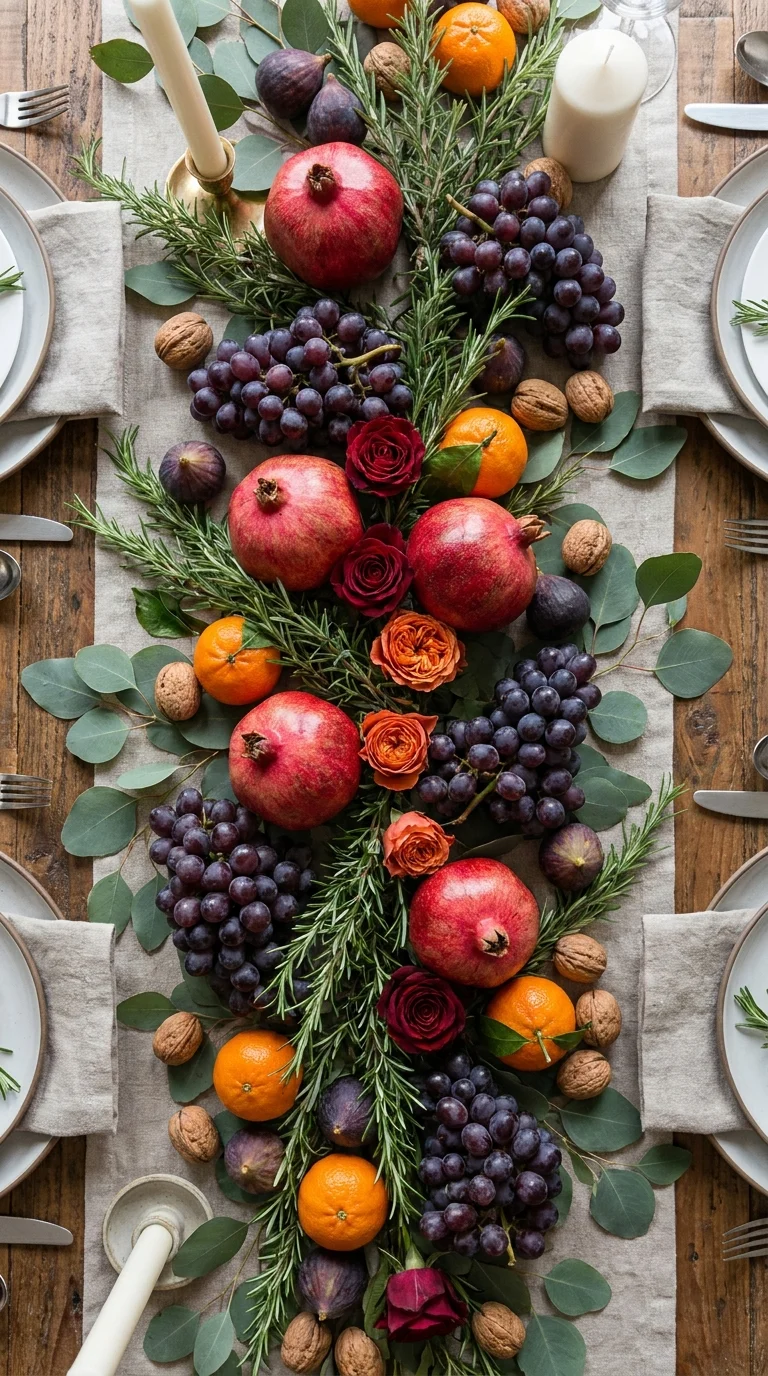
This is the one that gets the most comments from guests. Every single time.
The concept: a long, low runner of fresh fruit, greenery, and maybe some florals, arranged directly on the table or on a wooden board. Think clusters of grapes, small gourds, pomegranates, figs, and tangerines woven through sprigs of rosemary, bay leaves, and small flowers.
It looks like something from a Dutch Golden Age painting. And it’s actually edible, which means guests interact with it — they pick at the grapes, they smell the herbs. It becomes part of the meal rather than just decoration.
How to build it:
- Start with your greenery as the base — lay branches of rosemary, eucalyptus, or bay leaves down the center in a loose line.
- Add the larger fruits first — whole pomegranates, bunches of grapes, a cluster of pears.
- Fill in gaps with smaller items — figs, tangerines, whole walnuts still in shell, dried orange slices.
- Tuck in a few small flowers if you have them — even just a few heads of garden roses.
This works best for autumn and winter dinners. It’s also incredibly scalable — long table? Extend the runner. Small table? A single compact cluster works perfectly.
4. Herb Garden in Clay Pots
This is both beautiful and useful, which is a combination I love deeply.
Group three to five small clay terracotta pots of growing herbs in the center of the table. Rosemary, thyme, basil, mint, parsley. Keep them in their pots, place the pots on a wooden tray or piece of slate, and you’re done.
The smell is wonderful — not in an overpowering way, just gently fragrant. And at a dinner where you’re serving pasta or roasted chicken, guests can actually snip a sprig and add it to their plate. It’s interactive and practical.
What I learned the hard way:
The first time I did this, I bought basil plants from the supermarket and put them straight on the table. Within an hour, the heat from the candles I’d also placed nearby had started wilting them. Keep any live plants away from heat sources. Also, give the pots a little drink the morning before your dinner — you don’t want dry, droopy herbs on display.
5. Sculptural Branch Arrangement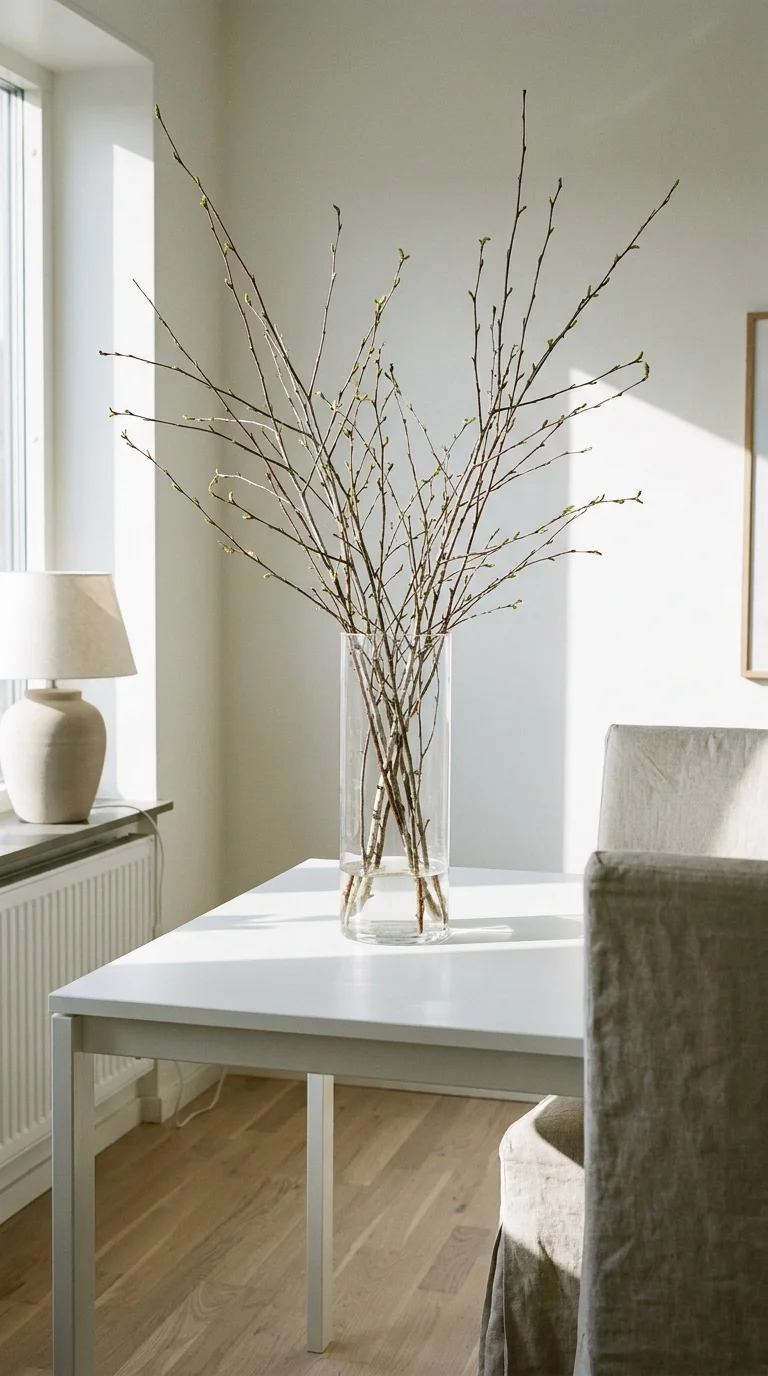
This one leans minimal and modern, and it photographs beautifully if that matters to you.
Find a few interesting branches — cherry blossom branches in spring, bare silver birch or twisted willow in winter, branches with dried seed pods in autumn. Arrange them in a tall, narrow vase (a simple glass cylinder works perfectly) and let the branches do their thing.
The branches should extend upward and outward past the vase but remain open enough that they don’t visually block anyone. Think of it like a living sculpture.
Where to find branches:
I get mine from my own garden, from neighbors who are pruning, or occasionally from a florist who sells them for a few dollars. Magnolia branches in late winter, before they fully bloom, are absolutely stunning. Cherry and apple branches with those first little buds are another favorite.
This works especially well in modern, minimalist dining rooms where a fussier arrangement would feel out of place.
6. Terrarium or Glass Garden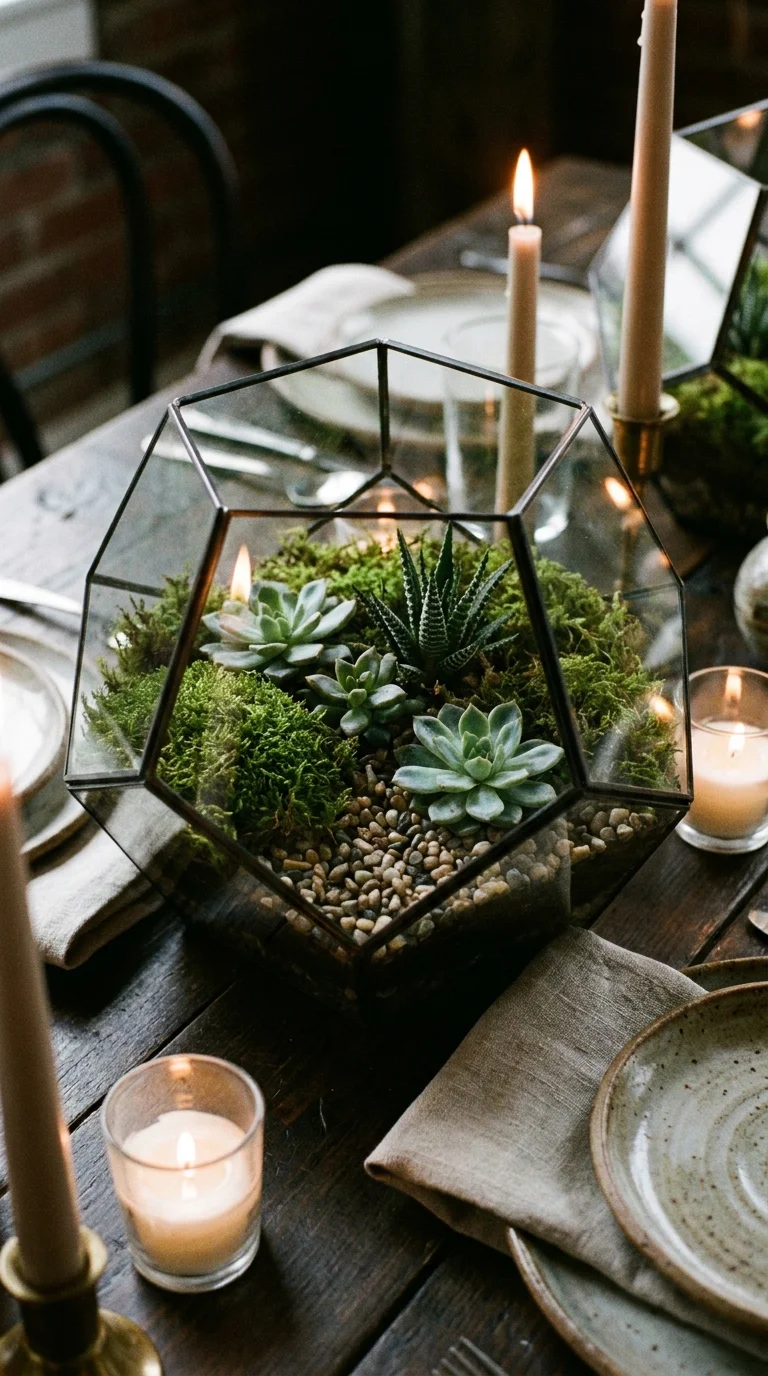
A glass terrarium on a dining table looks like you’ve brought a tiny, perfect little world to dinner.
This works best with a geometric glass terrarium — the kind with those angular facets that catch the light. Fill it with a layer of gravel, then activated charcoal, then potting mix, and then small plants: mosses, succulents, ferns, or air plants.
The beauty of this as a centerpiece is its longevity. Unlike cut flowers, a well-made terrarium can live on your table for months. I have one that’s been going for nearly two years.
Things to watch:
- Open terrariums for succulents and air plants. Closed terrariums for mosses and tropical plants.
- Don’t overwater. Most terrarium disasters come from too much water.
- Clean the glass occasionally — fingerprints and water spots show up badly in candlelight.
7. The Lantern and Greenery Combo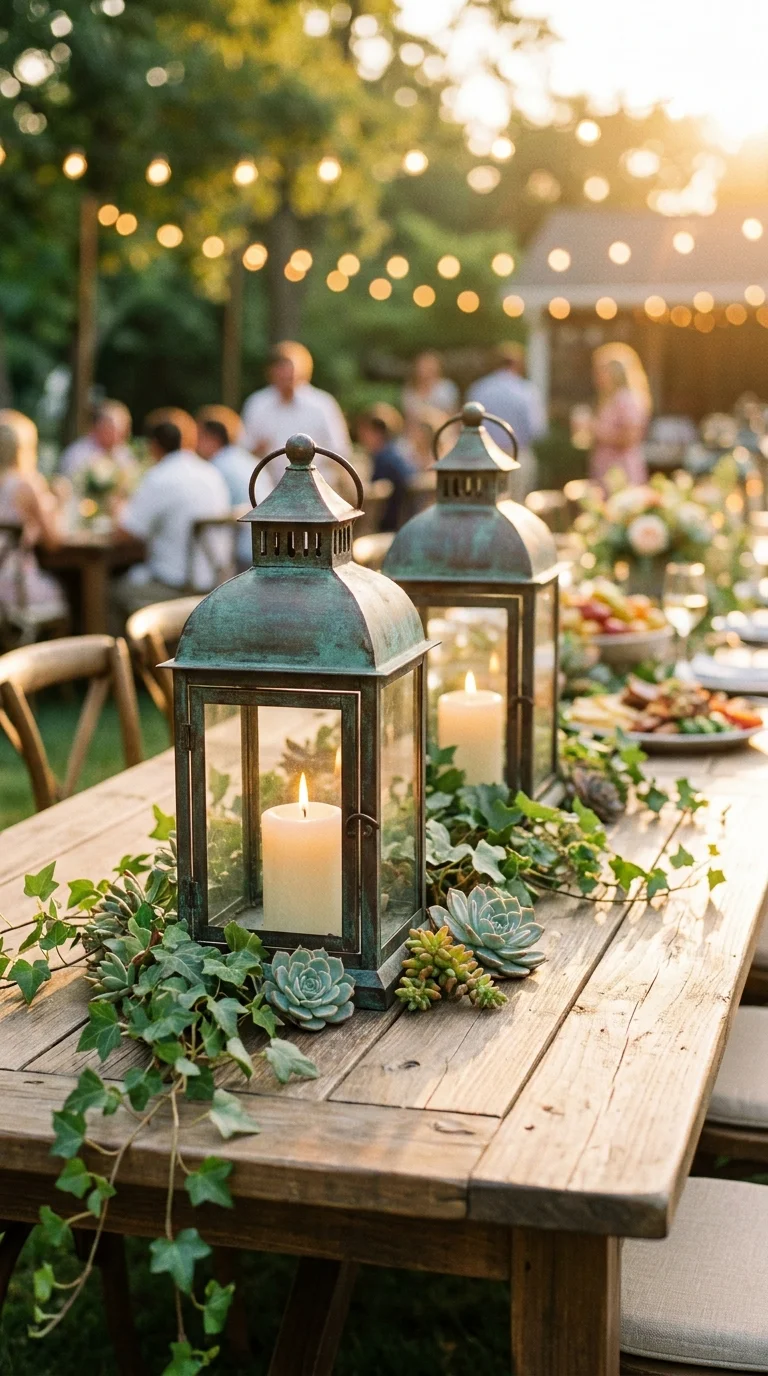
This is my go-to for outdoor summer dinners, though it works just as well inside.
Place one or two lanterns — the kind with glass panels and a candle inside — in the center of the table, and surround them with trailing greenery, vines, or small potted succulents. The lantern provides warmth and light; the greenery softens everything around it.
Outdoor metal lanterns are everywhere now at garden centers, IKEA, and places like TK Maxx. I have a few in different sizes that I mix and match. For outdoor evening dinners, the dancing candlelight through the glass panels creates an atmosphere that no electric light can replicate.
A mistake I made: Using real candles inside lanterns at an outdoor table when it was breezy. The candles blew out every few minutes. Now I use battery-operated flickering tea lights inside the lanterns outdoors — same look, zero frustration.
8. Floating Florals in a Wide Bowl
This one is genuinely one of the most effortless centerpieces you can make.
Fill a wide, shallow bowl — a salad bowl, a ceramic mixing bowl, even a casserole dish — with water. Float flower heads on the surface. Gardenias, roses, peonies, and camellias are ideal because their heads stay intact. Add a few floating tea-light candles among the blooms.
That’s it. It takes five minutes, costs very little (especially if you have flowers in your garden), and looks quietly spectacular.
The trick:
Cut the flower heads quite short — just an inch or two of stem. This keeps them low to the water rather than tipping sideways. Pick flowers with tight petals that won’t immediately shed — loose, fully open blooms will drop petals into the water within an hour or two.
9. The Seasonal Wreath, Laid Flat
This is one of those ideas that sounds odd until you see it and then immediately makes sense.
Take a Christmas wreath — or make a simple ring of greenery yourself using florist’s wire and garden clippings — and lay it flat on the table. Place a cluster of candles in the center of the ring.
For Christmas: pine, holly, and red berry wreath with cream pillar candles. For autumn: orange and rust dried floral wreath with dark bronze candles. For spring: a ring of fresh eucalyptus and small flowers with white taper candles.
This trick works so well because it gives you that layered, lush look without any height — so everyone can see across the table perfectly.
10. Succulent Garden Tray
This is the longest-lived centerpiece on this list. My succulent tray has been the centerpiece on my dining table, on and off, for three years.
Get a wide, shallow tray — wooden, ceramic, or galvanized metal. Fill it with a cactus and succulent potting mix. Plant a collection of small succulents — echeverias in their rosette forms, haworthias, sedums, string of pearls trailing over the edge, small aloe varieties.
Succulents need almost no care, survive drought, and stay put. Between dinner parties, this tray lives on my dining table most of the time. When I want something different for a special occasion, I move it aside. It’s earned its keep many times over.
For styling:
- Mix succulent varieties by texture and color — some with smooth round leaves, some with pointed geometric shapes, some trailing.
- Add a few stones, pebbles, or a piece of driftwood among the plants.
- A thin layer of fine gravel on top of the soil makes the whole thing look polished.
11. Vintage Books and Florals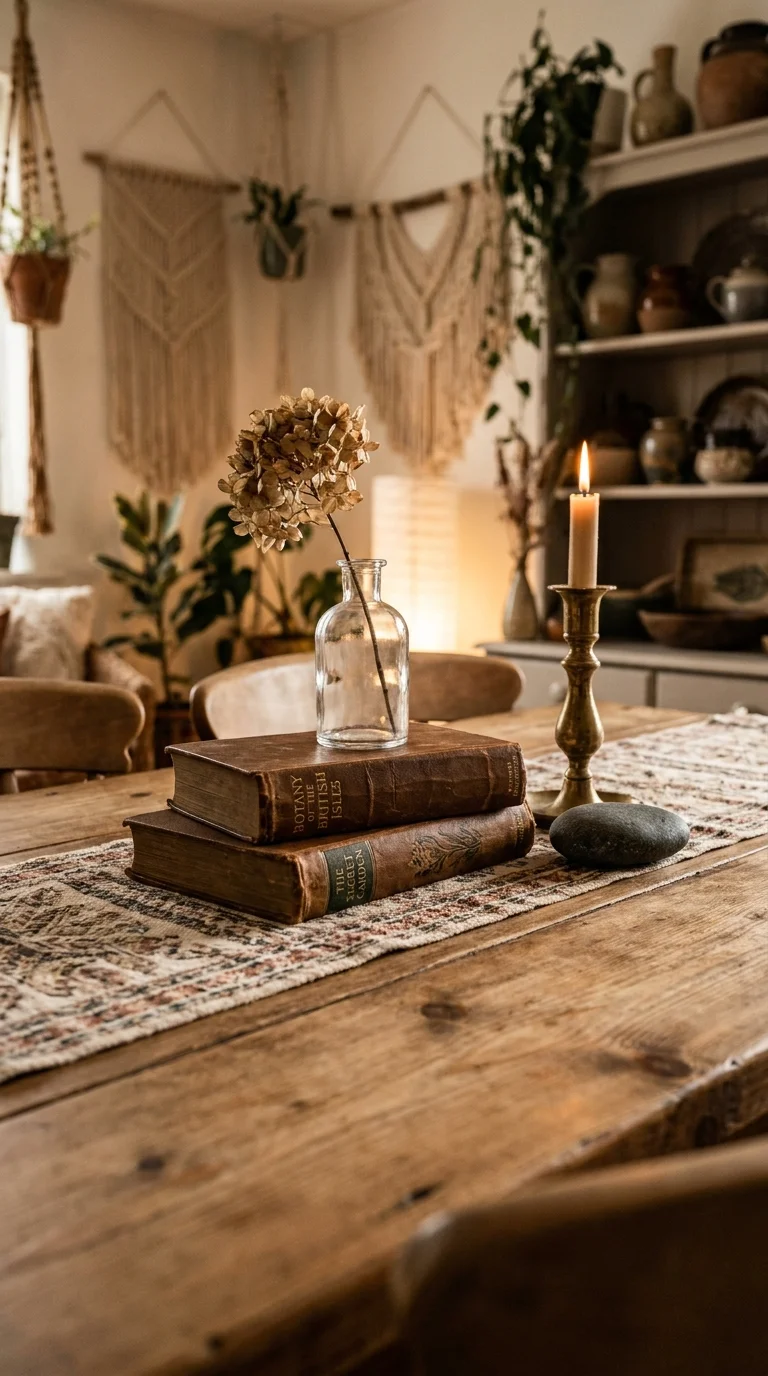
This is one for those with eclectic, maximalist, or bohemian homes — but when it works, it really works.
Stack two or three vintage hardcover books (look for old ones with interesting spines and covers at charity shops) in the center of the table. Place a small bud vase with a few stems on top. Scatter a couple of interesting objects around the base — a beautiful stone, a vintage candlestick, a dried seed pod.
The effect is like a curated moment. It feels personal, like a little story told in objects.
This centerpiece works better for smaller gatherings of close friends — it invites conversation and questions. “Oh, what’s that book?” is a great opening for a dinner table.
12. The Minimalist Single-Stem Arrangement
Sometimes the best centerpiece is the most restrained one.
Take a single dramatic stem — a protea, a giant allium, a bird of paradise, a single large orchid — and place it in a clean glass bud vase or narrow ceramic vase.
Nothing else.
For modern, minimalist, Scandi-influenced, or Japanese-inspired dining rooms, this is far more powerful than anything busier. One perfect stem says: I know exactly what I’m doing. And the drama of the single stem against a clean table is genuinely striking.
Where to find interesting single stems:
Farmers’ markets are the best source. Flower shops that cater to florists (as opposed to retail flower shops) often sell single stems affordably. Alliums, proteas, and dried pampas grass heads are all sturdy enough to stay beautiful for a week or more.
Mistakes I Made (So You Don’t Have To)
Over the years, I’ve made pretty much every centerpiece mistake possible. Here’s the condensed version of things I wish someone had told me:
Using strongly scented flowers. Gardenias are beautiful. They’re terrible on a dinner table. The scent genuinely overwhelms the food. Save them for hallways and bathrooms.
Going too tall. I once bought a gorgeous tall floral arrangement for a dinner party. The table of six became two separate conversations — the people on one side couldn’t see or hear the people on the other. I cut it down mid-dinner. Save height for mantlepieces.
Ignoring scale. A tiny bud vase on a large dining table looks lost. A massive arrangement on a small table looks aggressive. Always think about the scale of the table before designing the centerpiece.
Forgetting practicality. The time I put out a trailing arrangement that left flower stems near the edge of people’s plates. Nobody said anything but I noticed the awkward repositioning happening around the table all night.
Being too precious. I once spent over an hour on a complicated centerpiece for a casual pizza-and-wine night with friends. It was genuinely too much for the occasion and I ended up embarrassed by my own over-effort. Match your centerpiece energy to the occasion.
The Seasonal Switch
One thing that changed how I approach my dining table entirely was deciding to change my centerpiece seasonally rather than keeping one thing year-round.
Spring: Bud vases with garden flowers, soft greens, blossoms. Summer: Herbs in terracotta, low tropical leaves, floating florals. Autumn: The fruit and greenery abundance, gourds, dried elements, warm-toned candles. Winter: Candle clusters, pine and berry arrangements, lanterns, the flat wreath.
Doing this keeps the dining room feeling fresh and connected to what’s happening outside. And it gives you a reason to invest properly in a few different centerpiece options rather than trying to find one magical all-year solution (which doesn’t exist).
Budget Doesn’t Have to Mean Basic
I want to be clear about something: the most impressive centerpieces I’ve ever put together have also been among the cheapest.
The fruit and greenery abundance from my garden and a local market: around $8. The wildflower arrangement in a thrift store pitcher: about $5. The candle cluster I’ve had for years: the candles get replaced for a few dollars, but the candlesticks were a one-time charity shop find.
The expensive arrangements I’ve bought from florists have never outperformed the ones I assembled myself. Not because florists aren’t talented — they absolutely are — but because a centerpiece that feels personal and connected to your home and the season will always look more natural than something delivered in cellophane.
Grow a few things in your garden specifically for cutting. Buy interesting vessels when you see them at markets and charity shops. Keep a collection of candles in neutral colors. With these three things in rotation, you’ll never be caught with a bare table again.
Finding Your Style
After all of this — all twelve designs, all the seasonal switches, all the years of fiddling and adjusting — here’s what I’ve actually learned about dining table centerpieces:
The best one is the one that feels like you.
My sister does the wildflower-in-vintage-pitcher look better than anyone I know. My neighbor has those floating florals down to a fine art. My own thing, these days, tends toward the fruit and greenery runner in autumn and the sculptural branch arrangement in winter.
None of these is “the correct” answer. They’re all just ways of saying: I thought about this table, I thought about the people sitting around it, and I wanted it to feel like something.
That intention — that small act of care — is what guests actually feel, even if they can’t quite name it.
So try a few. See what fits your table, your style, your budget. Make the mistakes. The candle that drips, the flowers that wilt too fast, the arrangement that’s slightly too tall.
And then find your thing. And keep doing your thing.
Because a beautiful table, set with care for the people you love, is one of the genuinely small pleasures of a well-lived home life. Don’t overthink it too much.
Just make it feel like home.

Shahid Nawaz is a home and garden content writer at Garden Skillz with over 4 years of experience researching and writing about gardening, plant care, and DIY home improvement. He specializes in turning complex horticultural topics into practical, easy-to-follow guides for beginners and experienced growers alike. Shahid has written extensively on flowering plants, indoor greenery, and seasonal garden care.