I painted my bedroom teal on a Tuesday afternoon in March, completely on impulse and it was honestly one of the best decisions I’ve ever made for my home.
Here’s the honest backstory: I’d been staring at the same greige walls for four years. You know the color — that safe, inoffensive, “goes with everything” beige-gray that basically disappears. My bedroom looked like a hotel room that someone forgot to decorate. One afternoon, I was scrolling through Pinterest (dangerous habit, truly) and I spotted a bedroom with deep teal walls paired with warm brass accents and natural linen. Something clicked in my chest. That is what I want my room to feel like.
Three weeks later, I’d repainted, restyled, and completely fallen in love with my bedroom again for the first time since I moved in.
Now look — teal is NOT a one-size-fits-all color. I made mistakes. I had a brief panic when the first coat went on and looked almost green under my LED lights. I bought throw pillows I ended up hating. I learned a lot. And that’s exactly why I wanted to put this guide together — real ideas, honest assessments, the things that actually work.
Whether you’re thinking about going full teal walls or just want to dip your toe in with some accessories, there’s something here for every comfort level and every kind of bedroom. Let’s get into it.
Idea No. 01: The Deep Teal Accent Wall That Changes Everything

If you’re not ready to commit to teal on all four walls (fair enough — I wasn’t either, at first), the accent wall is your best entry point. And I’m not talking about a timid, washed-out teal. Go deep. Think Farrow & Ball’s “Vardo” or Benjamin Moore’s “Teal Ocean.” The kind of color that looks almost moody in photos but is absolutely incredible in person.
The wall that matters most is typically the one behind your bed — the headboard wall. This is the natural focal point of any bedroom, and when you paint it a rich, saturated teal, it essentially frames the entire room around your bed. Everything suddenly feels intentional.
I did exactly this in my own room before eventually going full teal, and I kept just the accent wall for about six months. My partner was skeptical. Then he walked in when it was done, stood in the doorway for a moment, and said: “Okay, this is actually incredible.” That’s the teal effect.
For the best result, use a matte or eggshell finish on bedroom walls — it absorbs light beautifully and gives teal that rich, saturated depth. Glossy finishes make teal look almost synthetic, like you painted your wall with a highlighter.
Pair your deep teal accent wall with white or very light linen on the other three walls. This keeps the room from feeling cave-like while still letting the teal be the star of the show.
Idea No. 02: Teal & Gold — The Combination That Feels Genuinely Luxurious

Of all the color combinations I’ve tried and researched, teal and gold is the one that consistently makes people stop and say, “Wait, did you hire someone?” It has this inherently expensive quality — like a boutique hotel or one of those beautifully curated Airbnbs you screenshot and send to your friends.
The reason it works so well is contrast. Teal is cool and sophisticated. Gold is warm and opulent. They balance each other out in a way that feels neither too cold nor too flashy. Neither color overpowers the other when you get the proportions right.
Here’s how to do it without it looking like a 2009 Moroccan-themed restaurant: keep the teal as your dominant color (walls, or a large upholstered piece) and use gold as your accent in smaller doses. Gold-framed mirror above the dresser. Brass bedside lamps. A gold-handled drawer pull. A couple of gold throw pillow covers.
The mistake people make is going 50/50. Too much gold and suddenly you’re in a Vegas casino. Let teal lead — roughly 70/30 is the sweet spot.
Idea No. 03: A Teal Velvet Headboard — The Single Best Bedroom Upgrade

If I had to pick one single change that gives you the most dramatic teal impact without touching your walls, it’s a teal velvet headboard. Full stop.
Velvet and teal were practically made for each other. The pile of velvet fabric catches light differently at every angle, which means teal velvet appears almost to shift between blue, green, and deep aqua depending on where you’re standing and what time of day it is. It’s genuinely beautiful in a way that photographs cannot fully capture.
A large, floor-to-ceiling or oversized panel headboard in teal velvet against white or light gray walls will transform your bedroom into something that looks like it belongs in an interior design magazine. And the great news is — you don’t need to spend a fortune. I’ve seen gorgeous options on Wayfair and Amazon in the $200–$500 range that look far more expensive than they are.
What to look for: a channel-tufted or plain panel design tends to photograph better and age more gracefully than heavily button-tufted styles. Go for the largest size your room can accommodate. Proportion matters enormously here — an undersized headboard looks lost, but an oversized one looks intentional and dramatic in the best way.
Teal isn’t just a color — it’s a decision to stop playing it safe. And once you make it, you can’t imagine your bedroom any other way.
— Sara Mitchell, Bloom & Nest
Idea No. 04: Teal Walls with Natural Wood — The Combination That Feels Grounded

One of the most common worries I hear from people considering teal is that it’ll feel cold. And I understand that — teal has a blue-green base that can read chilly, especially in bedrooms with limited natural light.
The fix? Natural wood. It’s that simple.
Warm wood tones — think honey oak, walnut, or even a lighter pine — work as the perfect thermal counterbalance to teal’s coolness. When you combine teal walls with a solid wood bed frame, wooden nightstands, or even just a wooden floating shelf, the room stops feeling cold and starts feeling earthy and alive.
This combination is particularly stunning in Scandinavian and Japanese-influenced interiors where you’re working with clean lines and natural materials. The teal provides the boldness, the wood provides the warmth, and together they create a bedroom that feels both modern and deeply comfortable.
Real example: my friend Kezia has teal walls in her bedroom with a solid walnut platform bed. No headboard, just the clean lines of the wood. White linen duvet. A single rattan pendant light overhead. It is one of the most serene, beautiful bedrooms I have ever been in — and it cost her less than $1,500 to put together by shopping secondhand.
Idea No. 05: The Coastal Teal Palette — Relaxed, Breezy, Effortlessly Beautiful
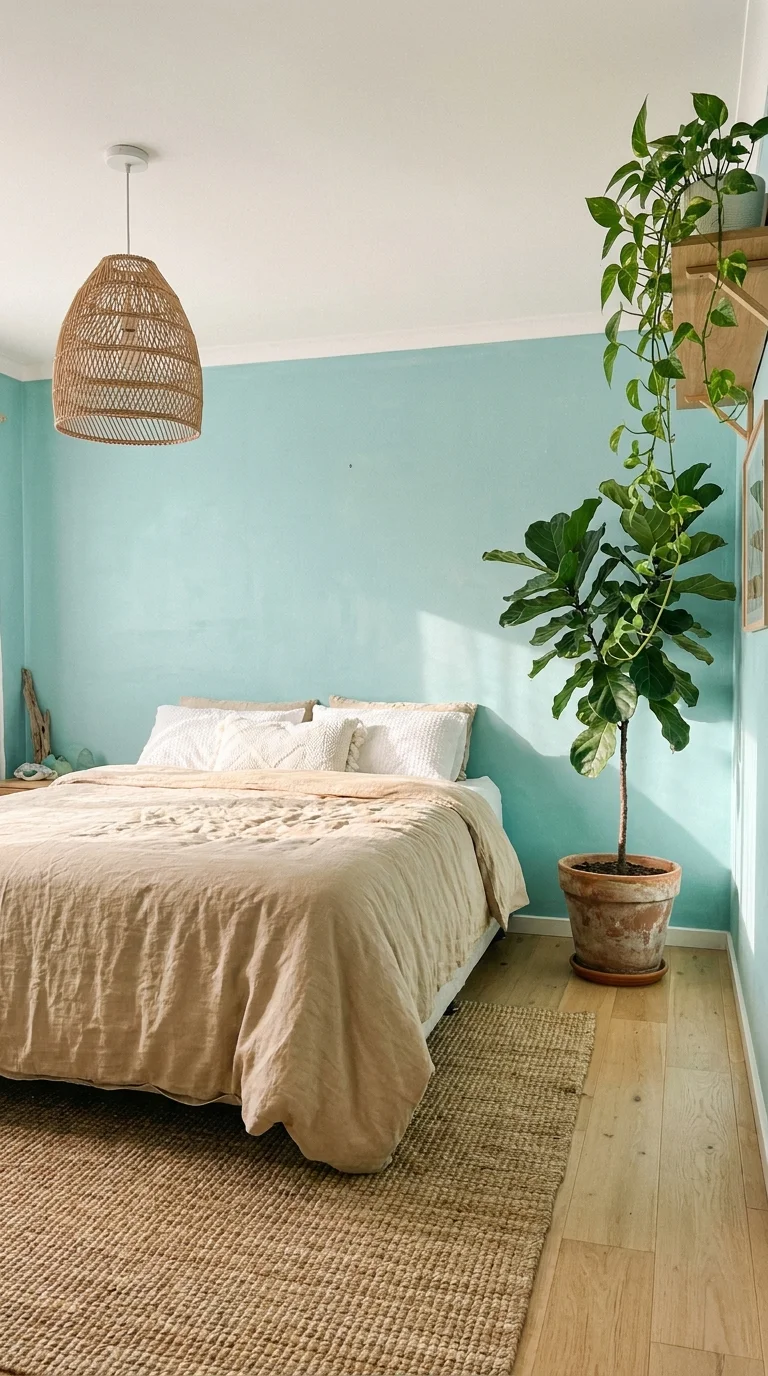
There’s a specific shade of teal — lighter, slightly washed out, reminiscent of shallow tropical water — that creates the most incredible coastal bedroom atmosphere. Not beachy in a cliché seashell-and-anchor way, but genuinely coastal in the way of a beautifully renovated house near the sea.
The palette builds around a lighter teal (think Sherwin-Williams “Interesting Aqua” or Behr’s “Bayside”) paired with sandy beige, natural white, and accents of coral or weathered navy. The result is a bedroom that feels perpetually on vacation.
Textures matter enormously in a coastal teal room. Linen duvet covers rather than crisp cotton. A jute area rug. Woven rattan lampshades. Macramé wall hangings (yes, they’re back and they look great if you don’t overdo it). These textures bring the warmth and tactile richness that stop a coastal room from feeling cold or too beach-themed.
Add some greenery — a trailing pothos on a high shelf, a large fiddle-leaf fig in the corner — and you’ll have a room that feels like a breath of sea air every single morning.
Idea No. 06: Painting the Ceiling Teal — Bolder Than You Think, More Beautiful Than You Expect

This is the one that makes people nervous. A teal ceiling. And I get it — the ceiling feels permanent, covering all the walls in dark paint-level scary. But hear me out, because a teal ceiling done right is absolutely breathtaking.
The key is to paint only the ceiling teal while keeping the walls white or very light. This creates a “jewel box” effect — like you’re looking up into the sky or a deep ocean. It adds color and drama without making the room feel enclosed, because the light walls keep everything open.
Interior designers often call this the “fifth wall” approach, and it’s one of those techniques that feels extremely sophisticated. Guests will notice something is different, but won’t immediately be able to identify what. “Your room feels so… cozy and special. Why is that?” Teal ceiling. That’s why.
For this to work at its best, the teal on the ceiling should be a shade or two deeper than you think you want. Ceilings naturally get less light than walls, so the color will appear lighter in situ than it does on the paint chip. Going a touch darker ensures the color reads as intentional rather than faded.
Idea No. 07: All-Teal Bedding — The Lowest Commitment, Highest Impact Move

Not ready to paint? Don’t own your home? Renting and your landlord would have a heart attack if you touched the walls? Teal bedding is your answer — and honestly, done right, it’s almost as impactful as painted walls.
The trick is to go for a full teal bedding look rather than just swapping out one element. That means a teal duvet cover, teal or teal-adjacent pillow shams, and then layering in texture through a chunky knit throw in a complementary color (mustard, cream, or rust all work beautifully).
When your bed is made, it becomes the centerpiece of the room — and if that centerpiece is rich teal against white walls, the whole room reads as deliberately designed. People assume you’ve done something significant when really you’ve just bought new bedding.
Brands I genuinely like for teal bedding: Brooklinen has consistently good teal shades in their linen line. Parachute does a beautiful peacock blue that reads as a perfect mid-teal. IKEA’s linen-cotton blend duvets in their teal offerings are honestly surprisingly lovely for the price and wash very well.
Layer, don’t just swap. Four to six pillows in complementary sizes and fabrics, not just two teal pillowcases on regular pillows. The layering is what makes it look like a styled bed rather than a bed with new sheets.
Idea No. 08: Moody Teal + Black — For the Person Who Wants Drama, Delivered

If you want your bedroom to feel like a grown-up, sophisticated, almost cinematic space, this is the combination. Moody, deep teal paired with matte black accents and warm lighting creates a bedroom that feels genuinely extraordinary after dark.
Think deep teal walls (the darkest end of the teal spectrum — almost teal-black in low light), matte black metal bed frame, black or very dark wood furniture, and then strategic warm lighting to prevent the room from feeling like a cave. Edison bulbs. Bedside sconces with warm amber light. A floor lamp with a fabric shade that diffuses the glow softly.
The key to making this not feel oppressive is texture contrast. If everything is dark and matte, the room will absorb all the light and feel heavy. You need shine — a high-gloss black frame on a mirror, a brass lamp base, velvet cushions that catch the light differently. These reflective and sheen elements bounce light around the room and keep it from feeling too dark.
White or very light bedding is also non-negotiable in a dark, moody, teal and black room. It’s your relief valve — the one bright element that prevents the room from tipping into oppressive territory and gives your eye somewhere to rest.
Idea No. 09: Teal & Blush Pink — Unexpected, Feminine, and Genuinely Stunning

I almost skipped this one because it sounds like it shouldn’t work. Teal and pink? Aren’t they basically opposites? And yes, they are — which is exactly why this combination is so interesting and vibrant when executed properly.
The pairing works because teal and blush occupy different temperature zones. Teal is cool; blush is warm. They’re color-wheel complements in the way that blue and orange are, creating natural visual energy without clashing.
This palette reads as sophisticated and editorial when you use a deep teal (not a bright teal) against a very muted, dusty rose blush (not a bright bubblegum pink). Think the blush of a dried rose petal, not a flamingo. Deep teal walls with blush linen curtains, a blush throw pillow, or a blush upholstered bench at the foot of the bed — chic, layered, and genuinely original.
I’ve seen this done incredibly well in several homes that feature a teal accent wall behind the bed and then blush tones in all the soft furnishings — curtains, bedding, rugs. The contrast is striking but harmonious. It’s a bedroom palette that photographs beautifully and lives even better.
Idea No. 10: Boho Teal — Layered, Textured, and Full of Personality

If your decorating style leans toward collected, layered, and full of personality rather than minimal and streamlined, teal is your boho color. It has enough depth and richness to anchor a maximalist, layered room without getting lost in the mix.
The boho teal bedroom layered approach: start with teal as your wall color or major textile (a large teal area rug, for instance). Then build on it with warm terra cotta accents, varied textile patterns (kilim pillow covers, a printed quilt, a woven wall hanging), lots of plants in varied ceramic pots, and a mix of wood and rattan furniture that doesn’t match perfectly but harmonizes.
The secret to boho rooms not looking chaotic is the repetition of two or three colors throughout the space — every element connects back to those anchor colors, even if the patterns and textures are wildly different. With teal as your anchor, look for accent pieces in terra cotta and cream, and your room will feel cohesive despite being gloriously layered and rich.
Some of my favorite finds for a boho teal room: vintage kilim pillowcases from Etsy sellers are incredible value and come in patterns that complement teal beautifully. Anthropologie’s home section consistently has beautiful teal-adjacent pieces. And thrift stores are gold mines for the mismatched rattan and wood pieces that give this style its character.
Idea No. 11: The Minimalist Teal Approach — For When Less Really Is More
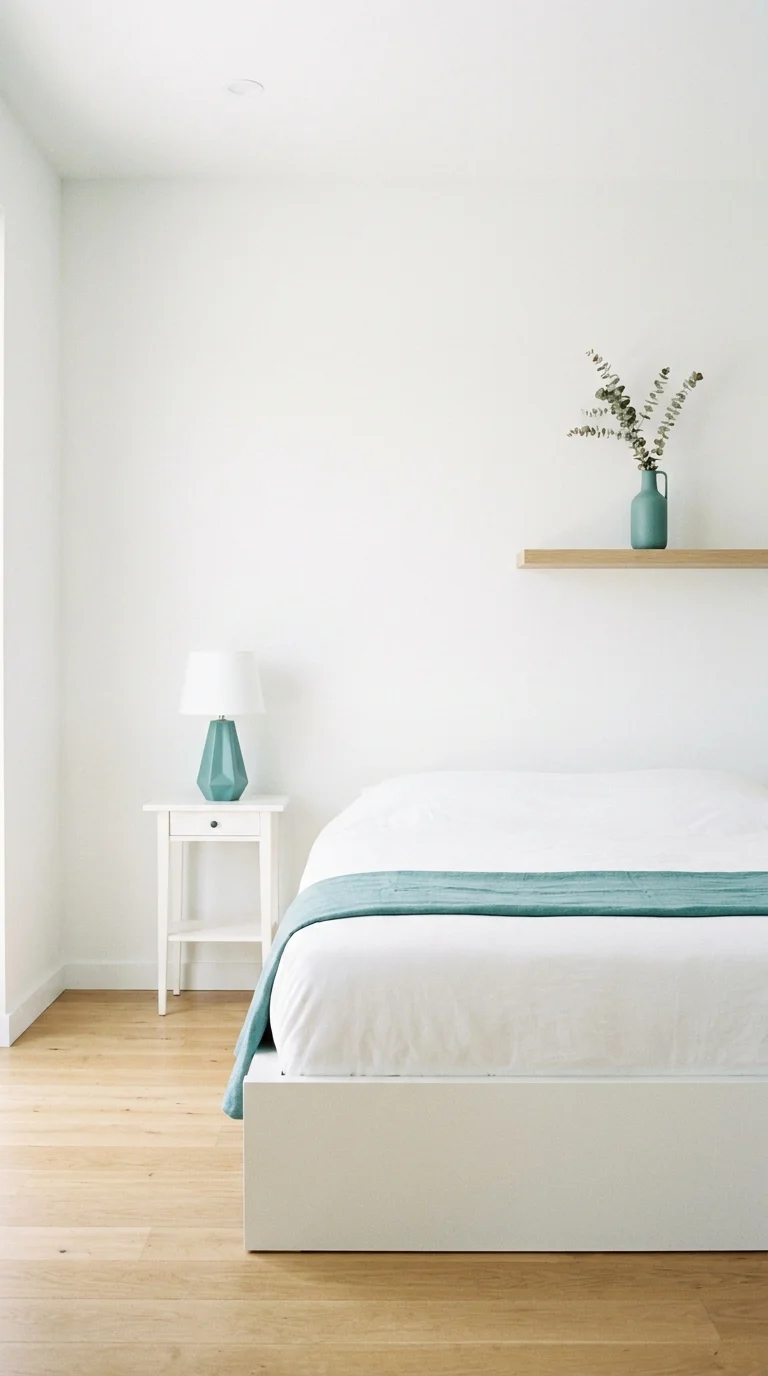
Not everyone wants drama and layering. Some of us want our bedrooms to feel like a clearing — sparse, intentional, and deeply restful. And teal works beautifully in a minimalist context too; it just requires a very different approach.
In a minimalist teal bedroom, color is deployed sparingly and precisely. Maybe it’s just a teal ceramic lamp on a white nightstand. Or a single large teal linen throw folded at the foot of a white bed. Or a teal vase with a single stem of eucalyptus on an otherwise bare floating shelf. One element, given space to breathe, can read louder than an entire room painted the color.
The minimalist approach also lets you play with teal as a secondary color while keeping the room primarily white or very light. This creates a bedroom that feels clean, organized, and restful — with just enough teal to give it personality and prevent it from feeling sterile.
If you love teal but you also love a bedroom that feels calm and uncluttered, this is your path. Resist the urge to add more pieces. Trust the restraint. The one beautiful teal thing — whether it’s a vase, a lamp, a chair — will carry more visual weight than you expect precisely because it isn’t competing with anything else.
Idea No. 12: Teal Built-In Shelving — The Permanent Commitment Worth Making

If you’re renovating, building out, or have a room with existing built-in shelving or cabinetry — paint it teal. This is one of those interior design moves that feels like pure transformation, the kind of thing that makes people say “this house is special” the moment they walk in.
Teal built-ins — bookshelves, a reading nook, a window seat with storage, flanking shelves on either side of a bed — create an architectural feature that reads as intentional, permanent, and beautifully designed. When the shelves themselves are teal, the objects displayed on them (books, plants, small ceramics) read against the teal like a curated gallery.
This works especially well if you keep the walls a lighter neutral. The teal built-ins become the feature without overwhelming the space. You get the drama of the color with none of the risk of feeling closed in.
I’ve seen this done in a bedroom where a full wall of shallow bookshelves flanking the bed was painted in a deep teal, with white walls on the remaining three sides. The effect was something between a library and a very high-end boutique hotel suite. Absolutely dreamy.
Finish Recommendation: Use a semi-gloss or satin finish on built-ins and cabinetry — unlike walls, where matte is king, the slight sheen on cabinetry helps them look deliberate and finished, and makes cleaning fingerprints and dust much easier.
Common Teal Bedroom Mistakes (And How to Avoid Them)
I’ve made most of these personally. Consider this the “learn from my pain” section of the article.
Choosing the wrong teal for your light
Choosing the wrong teal for your light
Teal is wildly light-sensitive. The same paint chip can look blue in north-facing rooms, green under warm bulbs, and perfectly teal in direct sunlight. Always test large swatches in your actual room at different times of day before committing to a full gallon.
Going too bright too fast
Bright, saturated teal looks incredible in inspiration photos, but can be exhausting to live with every day in a space as personal as a bedroom. Deep, muted teals are more restful and work harder across seasons and light conditions. Bright teal is a trend; deep teal is timeless.
Skipping the primer
If you’re painting over dark walls (or going from a light wall to deep teal), skimp on primer, and you will regret it. Dark colors require a tinted primer to read true, and without it, you’ll end up applying three or four coats of paint instead of two, costing you far more in time and product than the primer would have.
Mixing too many accent colors
Teal plays well with gold, blush, wood tones, black, and white. It does not play well with red, bright orange, or purple — and it definitely does not play well with all of them at once. Pick one or two accent colors and commit. More is rarely more when teal is involved.
Ignoring the curtains
Curtains cover a significant surface area in any bedroom. Bright white or jarring curtains will undermine even the most beautiful teal palette. Natural linen, sheer white, or curtains in a complementary warm neutral will integrate seamlessly. Patterned curtains should be chosen very carefully — one pattern too many and the room starts to fight itself.
Forgetting about the flooring
Teal walls with bright orange-stained oak flooring is a combination that rarely works, and yet it’s surprisingly common in older homes. If your flooring is a challenging color, consider a large area rug to create a visual buffer between the floor and your teal walls. A cream or warm gray rug can bridge almost any difficult floor-wall color relationship.
Buying all the accessories at once
I did this. I bought a complete “teal bedroom set” of accessories before I’d even painted, got them home, and realized half of them were the wrong shade or the wrong scale for the actual room. Build the room gradually. Paint first, sit with the walls for a week, then make accessory decisions based on how the color actually lives in your space.
The Thing Nobody Tells You About Teal Bedrooms
There’s something that happens when you finally commit to a bold bedroom color that I genuinely didn’t expect. The room stops being just a place where you sleep. It becomes a space you actually want to spend time in.
Before I painted my bedroom, I’d come home from work, sit in the living room, and barely think about my bedroom at all. It was just… the room with the bed. Now? I look forward to being in there. I read in bed more often. I don’t rush to get out of bed in the morning because the room itself feels like an experience. That sounds dramatic, maybe, but it’s real.
Teal is one of those colors that has genuine psychological weight. It’s associated with calm, clarity, and creative thinking. Interior psychologists (yes, that’s a real specialty) point to blue-green tones as being some of the most restorative colors for bedrooms — restful enough to sleep in, interesting enough to enjoy while awake. You’re not just making a style choice. You’re actually changing how the room feels to inhabit.
So whether you go all in with floor-to-ceiling deep teal walls and gold accessories, or you start with one beautiful teal velvet pillow on an otherwise neutral bed — I want to encourage you to do something. Move toward the bold choice. Your bedroom deserves more than beige. You deserve more than beige.
Start with the accent wall if you’re nervous. Grab a teal throw blanket this week if you’re very nervous. But start somewhere. Because once you see what teal does to a space — how it transforms a room from a place you sleep to a place you love — you won’t look back.
And if anyone gives you a hard time about the bold choice? Invite them over after it’s done. They’ll change their minds the second they walk in. They always do.

Shahid Nawaz is a home and garden content writer at Garden Skillz with over 4 years of experience researching and writing about gardening, plant care, and DIY home improvement. He specializes in turning complex horticultural topics into practical, easy-to-follow guides for beginners and experienced growers alike. Shahid has written extensively on flowering plants, indoor greenery, and seasonal garden care.