When my neighbor Sarah redid her front patio two summers ago, I honestly didn’t think much of it at first. She’d pulled out that cracked concrete slab that had been there since the 90s and replaced it with something I couldn’t quite put my finger on. It looked like it belonged in a narrow cobblestone alley somewhere between Florence and Seville — warm, textured, layered with potted herbs and climbing vines — and yet it was sitting right there on a suburban street in the middle of Ohio.
Three weeks after she finished, three different people had knocked on her door asking who did the work. One couple from down the street ended up hiring the same contractor. A real estate agent told her it had probably added $8,000 to $12,000 in perceived value to her property. Not bad for a patio project she’d pieced together mostly from Pinterest boards and one trip to a local tile importer.
That got me obsessed.
I spent the next year ripping up our own sad, mossy concrete patio, experimenting with materials, killing two olive trees (rest in peace), and slowly — through a lot of trial, error, and YouTube rabbit holes — building something I’m genuinely proud of.
So if you’re sitting on a dull outdoor space and want to give it some of that warm, effortlessly stylish European feel, I’ve got you. These aren’t vague “add some terracotta pots” tips. These are actual, actionable ideas with real context behind them — including the mistakes I made so you don’t have to.
Why European Patio Style Works So Well for Curb Appeal?
Before I get into the specific ideas, it’s worth understanding why this aesthetic hits so differently.
European patio design — whether you’re pulling from French Provençal, Italian courtyard, Spanish Moorish, or Greek island styles — all share a few common threads. They feel lived-in without being messy. They layer natural materials in a way that looks intentional but not over-designed. And most importantly, they’re built around time spent outside, not just decoration.
That philosophy translates beautifully to American yards, where outdoor spaces are often either too manicured and sterile or too cluttered and mismatched. European-inspired patios hit a sweet spot that’s visually rich, personally expressive, and deeply appealing to anyone who walks past.
1. Lay Irregular Flagstone or Reclaimed Cobblestone Instead of Plain Concrete

This was the single biggest change I made, and the one that had the most immediate visual impact.
Standard poured concrete looks fine when it’s new. Three years later, it’s stained, cracked at the edges, and has that weirdly clinical, parking-lot energy. Irregular flagstone — especially natural limestone, travertine, or reclaimed cobblestone — does the exact opposite. It actually looks better with age and weathering.
When I pulled up our old concrete, I found a salvage yard about 40 minutes away that carried reclaimed Belgian cobblestones. They were originally from a demolished street project and had this beautiful, worn-down patina you simply cannot fake with new materials. We used them as a central walking path and bordered them with irregular limestone slabs.
Practical tips here:
The key is to NOT lay them perfectly uniform. Leave slightly irregular gaps (about half an inch to an inch) and fill them with sand or creeping thyme — a low-growing herb that releases a lovely scent when you step on it and looks incredible. It’s a trick used all over Provençal farmhouses, and it absolutely works in a modern suburban setting.
If reclaimed cobblestone is too expensive or hard to source, look for “tumbled pavers” at places like MSI Surfaces or even a well-stocked Home Depot. Tumbling gives new pavers that aged, rounded look at a fraction of the cost of true reclaimed materials.
Mistake I made: I underordered the first time and had to reorder from a different batch. The color match was noticeably off. Always order 15-20% more than you think you need.
2. Build or Buy a Rustic Wrought Iron or Powder-Coated Metal Gate

Nothing announces “this is not an ordinary yard” like a beautiful gate — even if your patio doesn’t technically require one.
In France, Italy, and Spain, low decorative gates are used constantly, even for properties without full fencing. They define the boundary between the public sidewalk and the private patio space without walling anything off. They say: ” This is a curated space, not just a yard.
I found an absolutely beautiful arched wrought iron gate at a salvage shop for $120. It was rusty, honestly, kind of ugly, but the proportions were perfect — about four feet tall with a simple scrollwork design. Two cans of Rust-Oleum hammered black spray paint later, it looked like something from a Parisian courtyard.
If you’re not near a salvage shop, Etsy has an enormous range of hand-forged iron gates from small artisan blacksmiths. Search “wrought iron garden gate” and filter by the style you want — scroll-work for French, geometric cutouts for Moorish, simple vertical bars for Italian modern. Prices range from $200 to $800, depending on size and complexity, which is genuinely reasonable for something that changes the entire character of your entrance.
Pro tip: Even a gate that doesn’t fully swing open — one that’s more ornamental than functional — works great. Lean it against a low stone wall or position it between two planters for a framing effect.
3. Add a Pergola with Climbing Vines or Wisteria

This one takes time. I want to be upfront about that because I’ve seen too many blog posts act like wisteria just shows up fully formed.
We planted our wisteria three years ago. The first year, it was a stick. The second year, it finally started climbing. The third year — this past spring — it absolutely exploded, and our pergola looked like something out of a dream. It was 100% worth the wait.
A pergola with climbing plants is the defining feature of Italian and Greek patio design. It creates that dappled shade and sense of enclosure that makes an outdoor space feel like an actual room rather than just an open patch of ground.
You don’t need to hire a contractor for a pergola either. There are excellent DIY kits from companies like Yardistry (they use cedar) and Sunjoy that go up in a weekend with two people and basic tools. For a 10×12 structure you’re looking at $800 to $1,500.
What to plant on it:
Wisteria is stunning but aggressive — it will eat your gutters if you plant it too close to the house. Keep it on a freestanding pergola at least 6 feet from any structure.
For something lower-maintenance, try Clematis (fast-growing, gorgeous purple flowers), Climbing Roses, or a Grape Vine. The grape vine option is especially wonderful — it gives you a true Tuscan farmhouse feel, the leaves turn golden in fall, and if you pick a culinary variety, you get actual grapes.
4. Use Terracotta Pots — But Layer Them with Intention
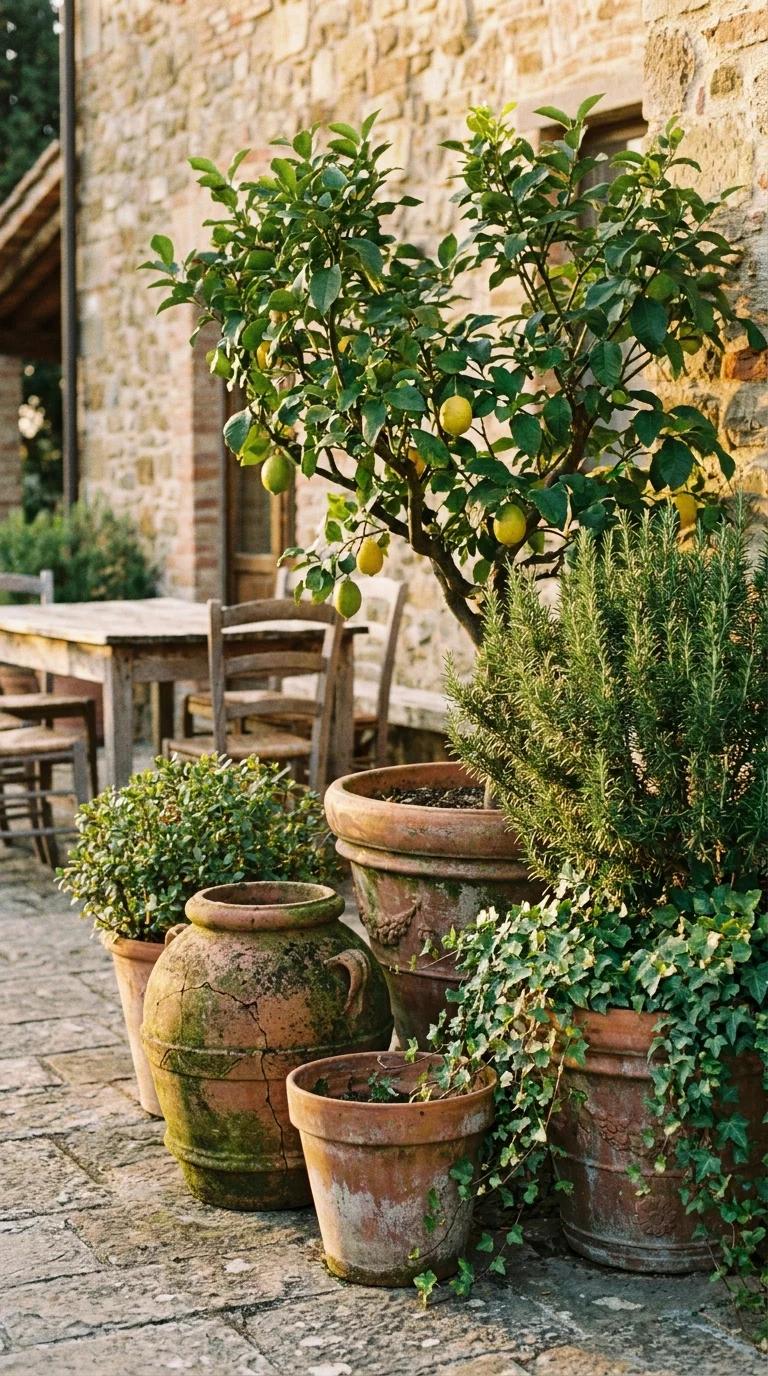
Okay, I know I said I wasn’t going to just say “add terracotta pots.” But the specific way you use them matters enormously, and most people get this wrong.
The mistake is treating terracotta pots as decoration. Europeans treat them as gardeners. There’s a difference.
In a Spanish or Italian patio, you’ll see terracotta pots of wildly different sizes — from tiny 4-inch herb pots on a windowsill to massive 24-inch statement pots flanking a doorway — grouped in casual, asymmetrical clusters. Some are weathered and mossy. Some are brand new. Some are painted, most aren’t. There are plants at different stages — some thriving, some a little rough around the edges.
That authentic imperfection is what makes it beautiful.
When I was trying to nail this look, I bought three large terracotta pots from a local nursery, aged them artificially (mix plain yogurt with water and paint it on — the bacteria encourage moss and algae growth within a few weeks), and grouped them with two smaller ones I’d had for years. I planted a lemon tree in the largest one, rosemary in two medium ones, and trailing ivy in the small ones.
The lemon tree is the star of the show. Even in Ohio winters, I bring it inside, and people ask about it all year long. It sets the tone immediately — this is a patio with personality.
Sources to know: Italian Terracotta (a US importer of genuine Impruneta terracotta from Tuscany) and Pottery Barn’s outdoor line have excellent large statement pots, though they’re pricier. For budget-friendly aging, IKEA’s INGEFÄRA pots are great and weather beautifully.
5. Install a Stone or Tiled Outdoor Dining Table
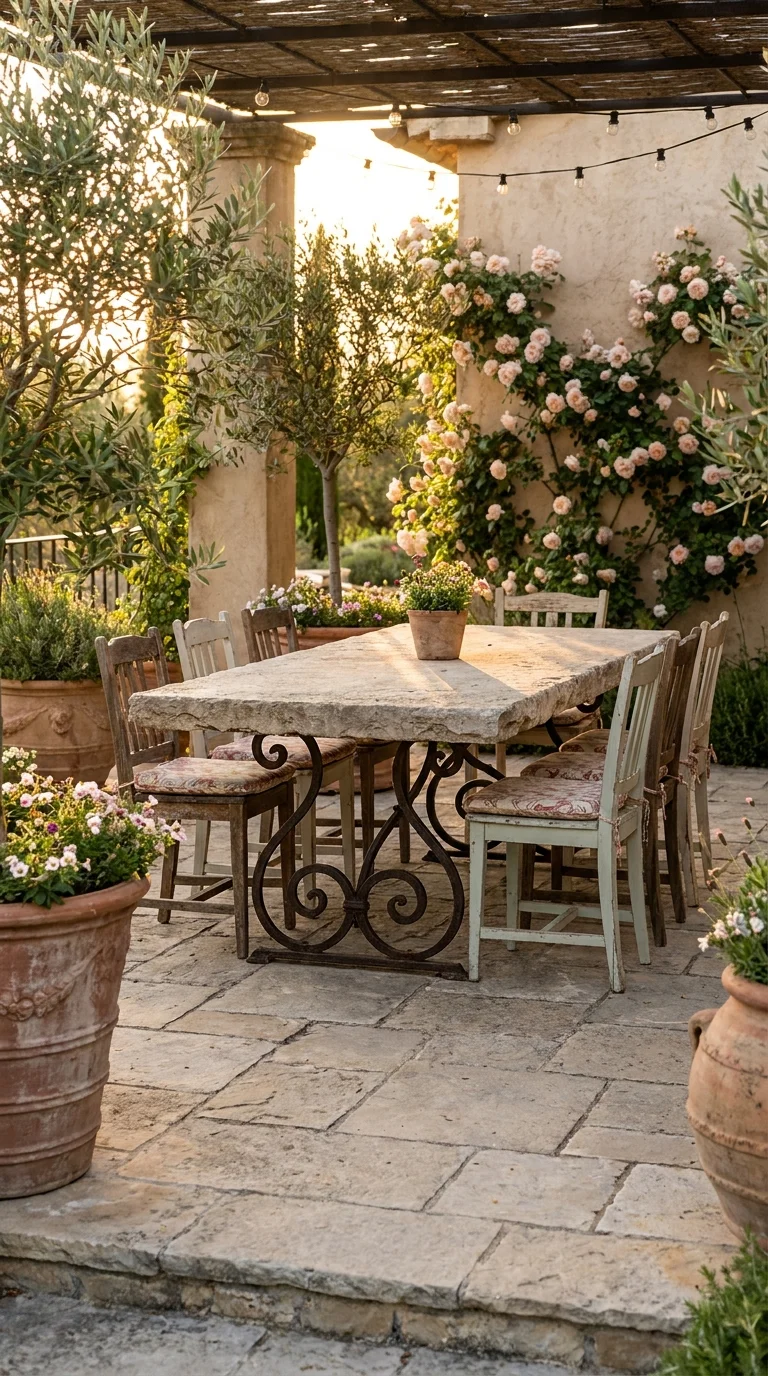
This one changed how we actually use our patio.
Before, we had a standard metal-and-glass outdoor table from Target. It was fine. We used it maybe twice a week in summer. After replacing it with a stone-topped outdoor dining table, we eat outside probably five nights a week from May through September.
There’s something psychological about a substantial, well-made table. It signals that this is a real dining space, not a temporary setup. You stop treating it like a maybe and start treating it like a given.
For a European look, you want either: a natural stone top (limestone, slate, or travertine) on an iron base, or a hand-painted ceramic tile mosaic top. The tile mosaic version has a very specific Mediterranean market feel — think Morocco meets Andalusia — and it’s actually achievable as a DIY project if you’re patient.
I went with a limestone-top table from a local stone yard that cut me a 36×60-inch slab for $280. I paired it with a wrought iron base I found at an estate sale ($45) and had a welder attach it. Total cost: around $350 for a table that looks like it cost $1,500.
If DIY isn’t your thing, World Market (Cost Plus) sells some genuinely beautiful Mediterranean-style outdoor tables at reasonable prices, and Wayfair has a huge range if you’re willing to dig.
6. Create a Focal Point with a Wall Fountain or Basin
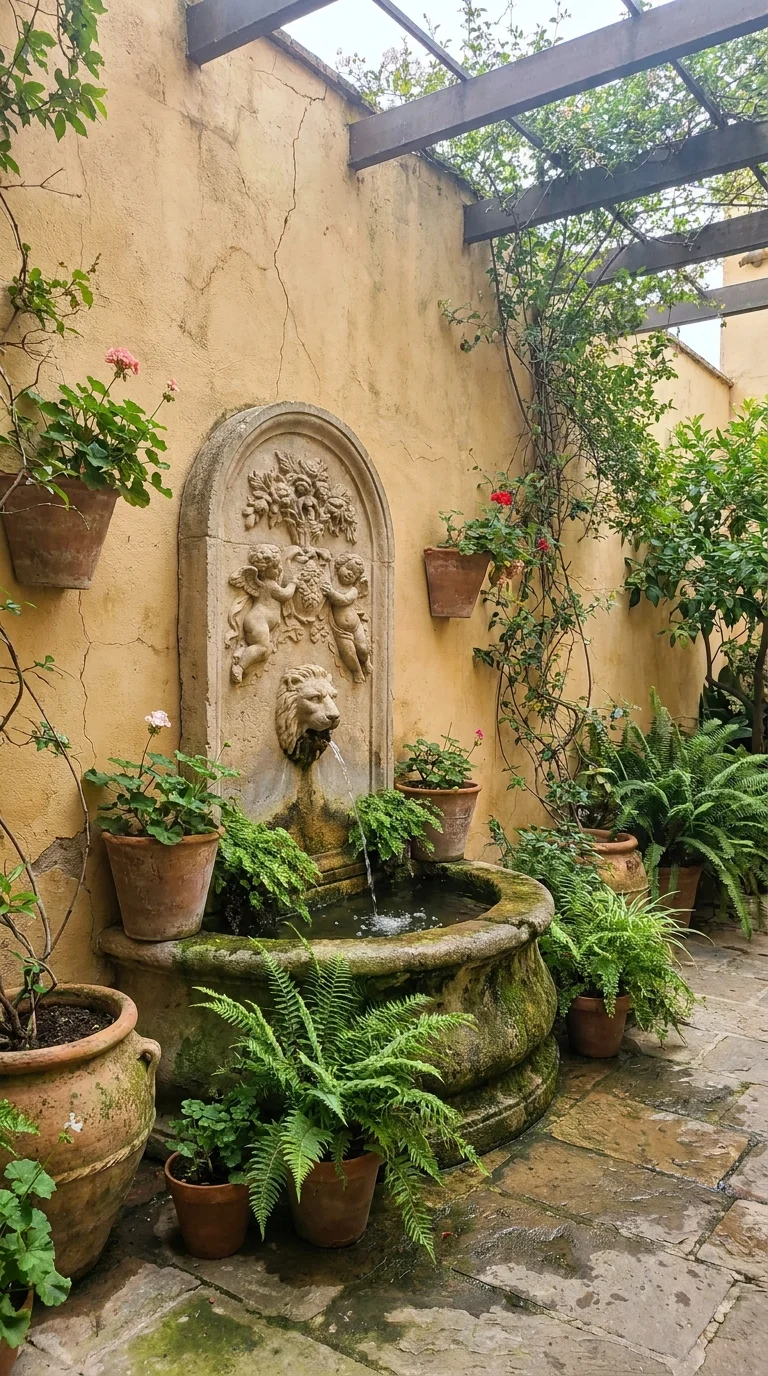
This is the idea most people skip because it sounds expensive or complicated. It’s often neither.
Wall fountains are central to Moorish Spanish design and pop up all over Italian and French courtyard gardens, too. The sound of running water is transformative — it creates ambient noise that makes your patio feel more private and peaceful, even on a busy street.
I installed a cast stone wall fountain from a garden center for $380. It runs on a simple recirculating pump (included) that plugs into a standard outdoor outlet. Installation took a Saturday afternoon, and my husband, who is not particularly handy, managed it without any professional help.
The alternative to a full wall fountain is a simple stone basin or birdbath with a small solar-powered fountain bubbling up from the center. You can pick up solar fountain pumps on Amazon for around $25, drop them into any basin or bowl, and the effect is lovely and costs almost nothing to run.
One thing I didn’t expect: The birds. Once we had moving water in the yard, the number and variety of birds that visited absolutely exploded. It made the whole space feel alive in a way static features just don’t.
7. Use Warm, Layered Outdoor Lighting (Skip the String Lights)
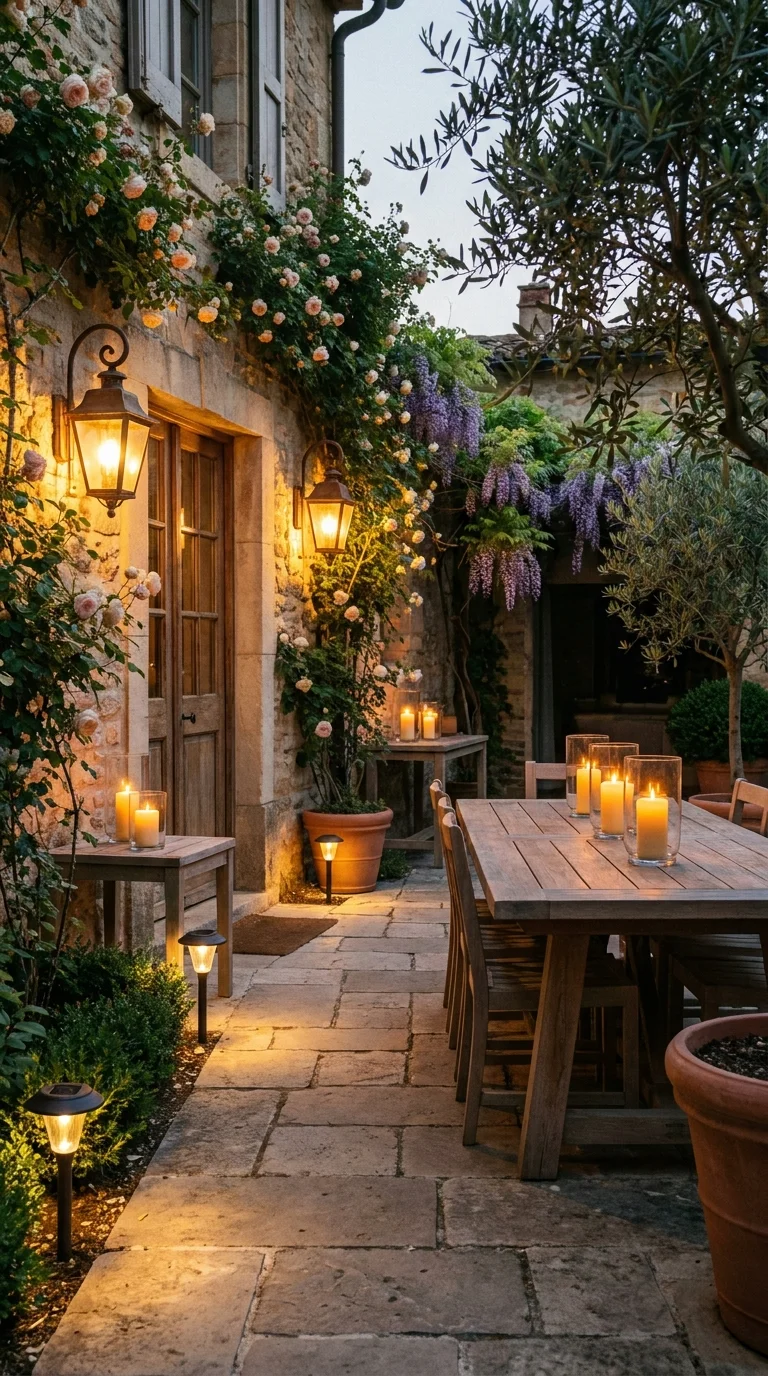
I’m going to say something controversial: string lights are overused to the point of visual noise now. They’re everywhere. They’ve become the “Live Laugh Love” of patio decor.
European outdoor lighting tends to be more deliberate and varied. Instead of one mass of twinkling overhead lights, think about layers: low path lights tucked into planting beds, lanterns on tables, a wall sconce beside the door, and maybe candles in weather-resistant holders for evenings.
My current setup uses: two flush-mount wall lanterns in an aged bronze finish flanking our front door (hardwired, so they come on at dusk automatically), three low solar path lights along the flagstone walkway, and a set of pillar candles in hurricane glass holders on the dining table for evenings.
The lantern style is important. For a European feel, avoid anything with a nautical or farmhouse aesthetic — those lean American. Look for lanterns with simple, clean lines or scrollwork detail. Arhaus, Restoration Hardware, and even IKEA (their SOLVINDEN outdoor lanterns are great) all have good options.
Mistake to avoid: Don’t overlight. More lights don’t mean more ambiance. If your patio is blazing like a car dealership at night, no amount of beautiful stonework will save it. Aim for warm, dim, and layered.
8. Plant a Low Hedge or Lavender Border

Borders matter. The line between your patio and the lawn or street is where a lot of European design does its most subtle, important work.
In Provence, you’ll see lavender everywhere — not just as decoration but as a functional border plant that marks paths, frames doorways, and releases scent whenever you brush past. English lavender (Lavandula angustifolia) is easy to grow in most American climates, requires almost no maintenance once established, and smells absolutely incredible.
I planted a double row of ‘Hidcote’ lavender along the edge of our flagstone patio about two years ago. In summer, it blooms in deep purple, and the whole front of the house smells like a French countryside market. Neighbors slow down walking past. It’s that noticeable.
Other excellent European border plants: Rosemary (doubles as a cooking herb), Boxwood (very French formal garden), Salvia, and Catmint. All are low-maintenance, drought-tolerant once established, and visually clean.
Important: Plant lavender in full sun and well-draining soil. It will die in clay soil or anywhere that stays wet. I killed my first round of plants before I understood this. Add gravel to the planting area if your soil is heavy.
9. Add a Mosaic or Hand-Painted Tile Feature Wall
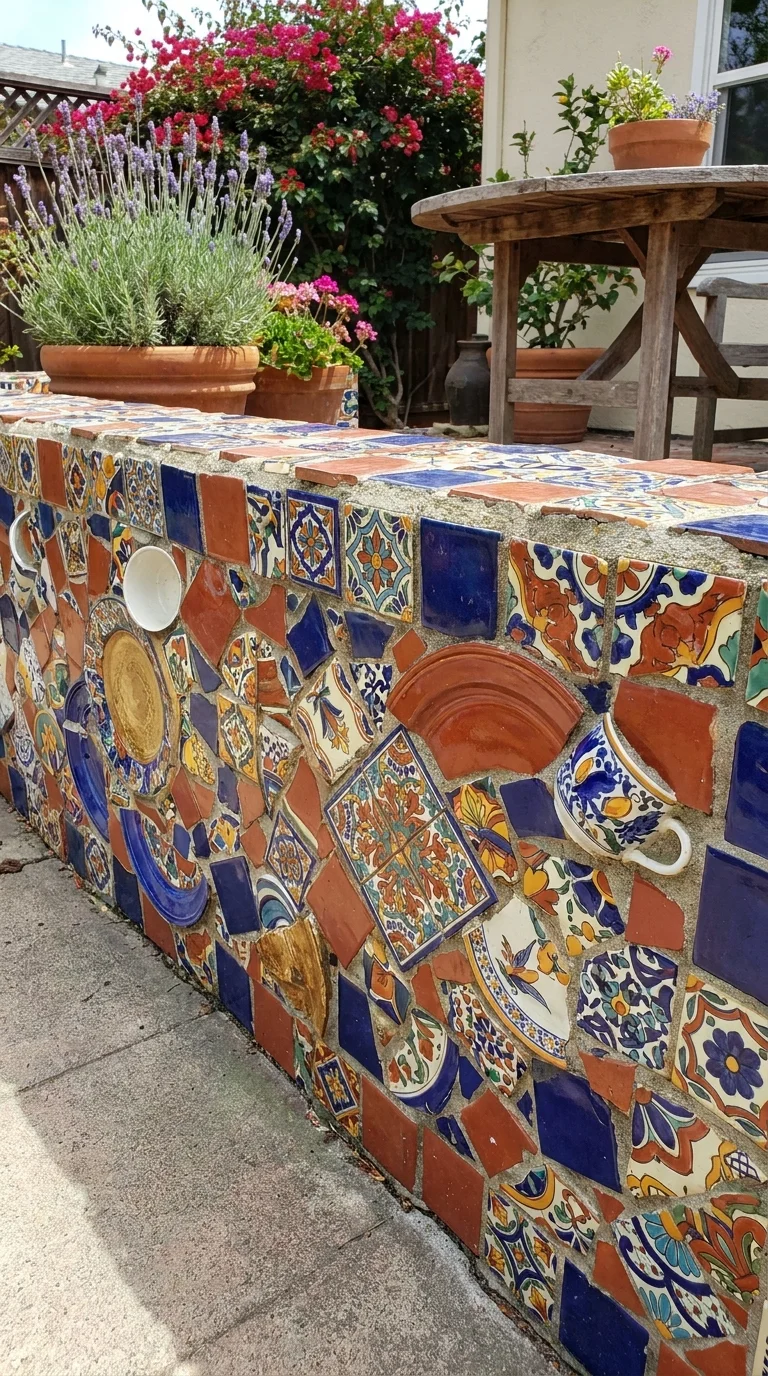
This is the idea that gets the most comments from visitors.
We have a low retaining wall at the edge of our patio — about two feet tall and eight feet wide — that was plain concrete block. Last summer, I spent three weekends covering it in a simple mosaic made from broken ceramic tiles I sourced from a tile clearance center (they sell discontinued and broken stock for next to nothing) and a few Spanish hand-painted decorative tiles I ordered from Etsy.
The result is colorful, deeply personal, and absolutely unmistakably Mediterranean. It took patience, basic tile adhesive and grout, and a lot of YouTube tutorials on mosaic technique. The total cost was maybe $90. The impact is enormous.
If you’re not up for a full mosaic, even adding a single row of hand-painted Talavera or Spanish Azulejo tiles as a border along a plain wall, planter, or step riser makes a tremendous difference. These decorative tiles are inexpensive (often $2-6 each on Etsy or from Mexican tile importers), and you only need a small number to make an impact.
Search for: “Talavera tiles” for Mexican-Spanish style, “Azulejo tiles” for Portuguese/Spanish style, or “Zellige tiles” for a Moroccan influence.
10. Furnish with Natural Materials — Rattan, Teak, or Wrought Iron

The furniture choice ties everything together, and here the rule is simple: choose natural materials and avoid plastic or synthetic resin at all costs.
European outdoor furniture is almost always rattan, teak, wrought iron, or powder-coated aluminum with natural fiber cushions. These materials weather gracefully, look better over time, and feel like they belong in an outdoor space.
Plastic resin furniture — even quality Polywood — tends to look temporary and suburban, no matter how nice the rest of your space is. It’s the furniture equivalent of wearing running shoes with a nice outfit.
For sourcing, World Market has excellent rattan and teak pieces at accessible prices. Serena & Lily is beautiful but expensive. Facebook Marketplace and estate sales are gold mines for vintage wrought iron furniture that just needs new cushions.
My best find: A wrought iron bistro table and two chairs at an estate sale for $35. They’d been sitting in someone’s garage for 20 years, were slightly rusty, but were solid as a rock. Wire-brushed, primed, and painted with Rust-Oleum 2x Flat Black. New cushions from World Market in a faded terracotta stripe. They’re the most-commented-on pieces on our entire patio.
Common Mistakes to Avoid When Doing European Patio Design
After doing this myself and talking to a lot of people who’ve tried it, here are the traps I see most often:
Going too matchy-matchy. European patios have an evolved, collected look. Buying a complete matching furniture “set” in one shopping trip almost always looks artificial and American. Mix eras and styles.
Skipping maintenance plans. Natural materials require seasonal care. Teak needs oiling. Iron needs touch-up paint on chips. Stone needs sealing every few years. None of this is hard, but if you skip it, beautiful materials start looking rough fast.
Overcomplicating the plant selection. I’ve seen people plant 15 different species in an attempt to look “European,” and it just looks busy. Pick 3-4 plants and commit to them in quantity. Repetition reads as intentional.
Ignoring scale. A tiny bistro table in a large patio looks lost. A massive dining table in a small courtyard looks claustrophobic. Measure your space and mock up furniture placement with painter’s tape before buying anything.
Using too many “themes.” Don’t mix Spanish tile with Greek whitewash with French wrought iron all in the same space. Pick one regional influence and lean into it. The coherence is what makes it look designed rather than random.
Where to Get Inspired Before You Start?
A few resources that genuinely helped me and aren’t just generic Pinterest boards:
Houzz has incredibly detailed photo collections filterable by style — search “European courtyard” or “Mediterranean patio,” and you’ll get real projects with real material lists. Homeowners often comment on sources.
The Sill and Terrain both have strong editorial content on European garden and patio aesthetics, mixed with product options.
YouTube channels like “Roots and Refuge Farm” and “Garden Answer” aren’t specifically European but have deep plant knowledge that helps when you’re planning a living patio garden.
For tiles specifically, I’ve had great experiences with Fireclay Tile, Granada Tile, and small Etsy sellers who import directly from Spain and Portugal. Real, handmade tiles have imperfections that are actually desirable — they’re part of the charm.
The Payoff Is Real — and It Happens Faster Than You Think
I want to end on something practical: you don’t have to do all ten of these at once. In fact, I’d actively suggest you don’t.
Start with the flooring change or the furniture upgrade — whichever feels most urgent for your space. Live with it for a season. See how it shifts the way you use the patio and how you feel about the space. Then layer in the next thing.
That’s actually how European patios come to look so authentic — they’re built over time, not installed in a weekend. Each piece has a story. That lemon tree came from a farmers’ market. That bistro table came from someone’s grandmother’s estate. That mosaic wall was a quarantine project.
The spaces that feel most genuinely charming aren’t the ones that were planned to the last inch. They’re the ones that grew organically from someone’s taste, experience, and actual life.
Your patio can be that space. It’s closer than you think.
Questions about sourcing, plant selection, or any of the specific techniques I mentioned? Drop them in the comments — I check regularly, and I genuinely enjoy talking through this stuff.

Shahid Nawaz is a home and garden content writer at Garden Skillz with over 4 years of experience researching and writing about gardening, plant care, and DIY home improvement. He specializes in turning complex horticultural topics into practical, easy-to-follow guides for beginners and experienced growers alike. Shahid has written extensively on flowering plants, indoor greenery, and seasonal garden care.