I still remember standing in the paint aisle at my local hardware store, completely overwhelmed, holding two paint chips side by side — one labeled “Eucalyptus Mist” and the other “Sage Whisper.” My bedroom at the time was a beige box. Not cozy-beige. Just… sad-beige. The kind of room that makes you feel like you’re sleeping inside a cardboard box.
A friend had sent me a photo of her sister’s bedroom a few weeks earlier — muted green walls, linen bedding, a rattan mirror — and I couldn’t stop thinking about it. That color. That calm. I wanted it so badly, but my budget was barely $150. I genuinely thought a beautiful sage bedroom was something only people with Pinterest-perfect homes and interior decorators could pull off.
Turns out I was completely wrong.
Over the past couple of years, I’ve transformed my bedroom (and helped two friends do the same) using sage green as the foundation — all without spending a fortune. I’ve learned what works, what looks cheap, what’s totally worth splurging on even on a small budget, and what mistakes I made that I wish someone had warned me about.
So here are 9 gorgeous sage bedroom looks that you can actually recreate without draining your bank account. Real tips, real prices, and a few honest “oops, don’t do that” moments included.
Why Sage Green Is Having Such a Moment (And Why It Works in Bedrooms)?
Before we get into the looks, let me just say — sage is not just trendy. It’s genuinely one of the most versatile, calming, and flattering colors you can put in a bedroom.
It’s in that sweet spot between green and grey, which means it works with warm tones (wood, terracotta, mustard) and cool tones (white, navy, dusty blue). It doesn’t shout. It just quietly makes everything look more intentional.
And because it’s a soft, muted shade, it’s incredibly forgiving if you’re mixing and matching pieces from different sources — which, when you’re on a budget, you almost certainly will be.
Okay. Let’s get into the looks.
Look 1: The Painted Accent Wall (Budget: $30–$60)
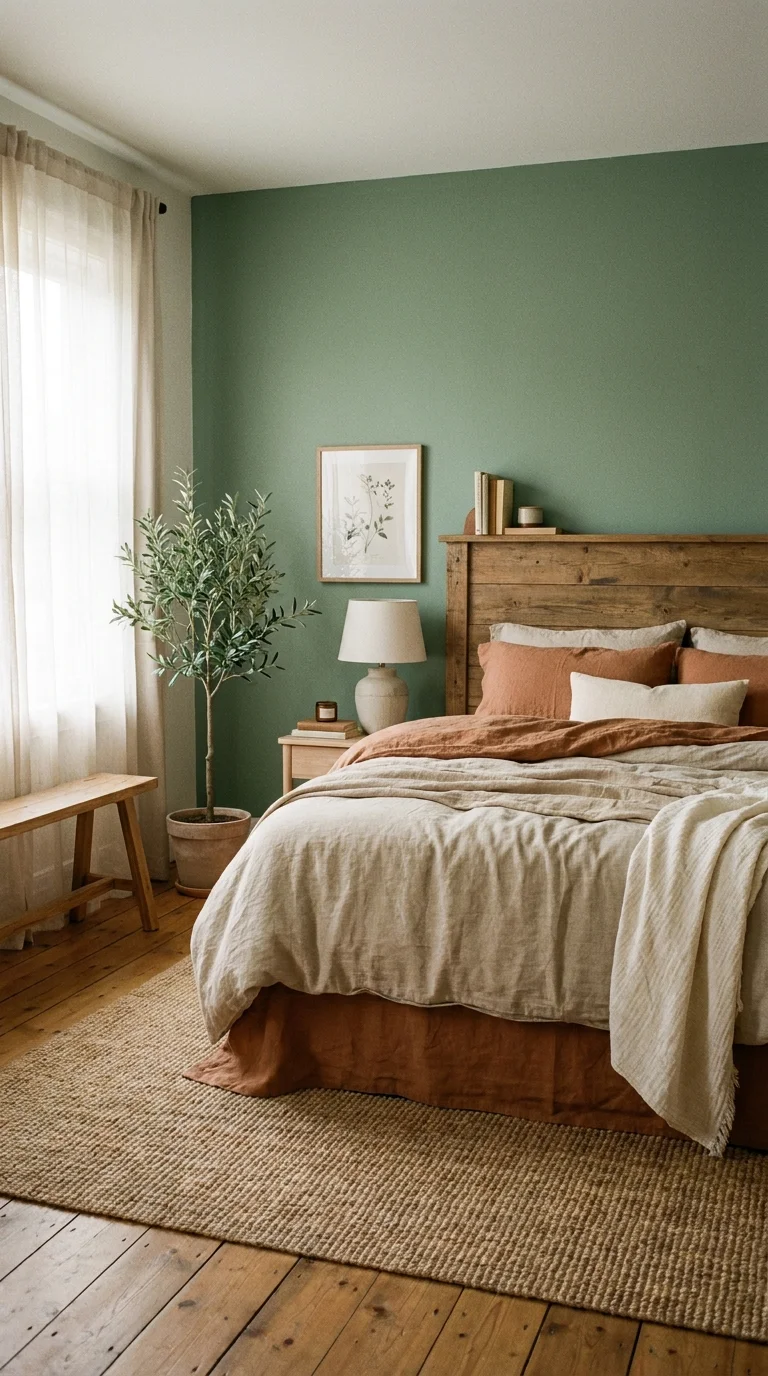
This was the first thing I tried, and honestly, if you’re totally new to sage bedrooms and don’t want to commit to painting all four walls, this is the perfect entry point.
Pick the wall behind your headboard. Just that one wall.
I used Behr “Aged Jade” from Home Depot — a single quart was enough for one accent wall in my medium-sized room, and it cost around $20. I added a second coat for richness and the whole thing took a Saturday afternoon.
The transformation was wild. One wall, one color, and suddenly my bedroom felt intentional. Like someone who cared about it lived there.
What I learned the hard way: Don’t skip primer, especially if your walls are currently white. I skipped it the first time and had to do three coats instead of two. Buy the primer. It’s worth the extra $8.
Affordable paint brands to check out:
- Behr (Home Depot) — great coverage, fair price
- HGTV Home by Sherwin-Williams (Lowe’s) — consistent color matching
- Clark+Kensington (Ace Hardware) — underrated, very pigmented
If you want to see the color before committing, Samplize sells peel-and-stick paint samples for about $5 each. I used these before my second room makeover, and it saved me from a color I thought I wanted (spoiler: it looked totally different on my actual walls than on my phone screen).
Look 2: The Linen Bedding Refresh (Budget: $40–$90)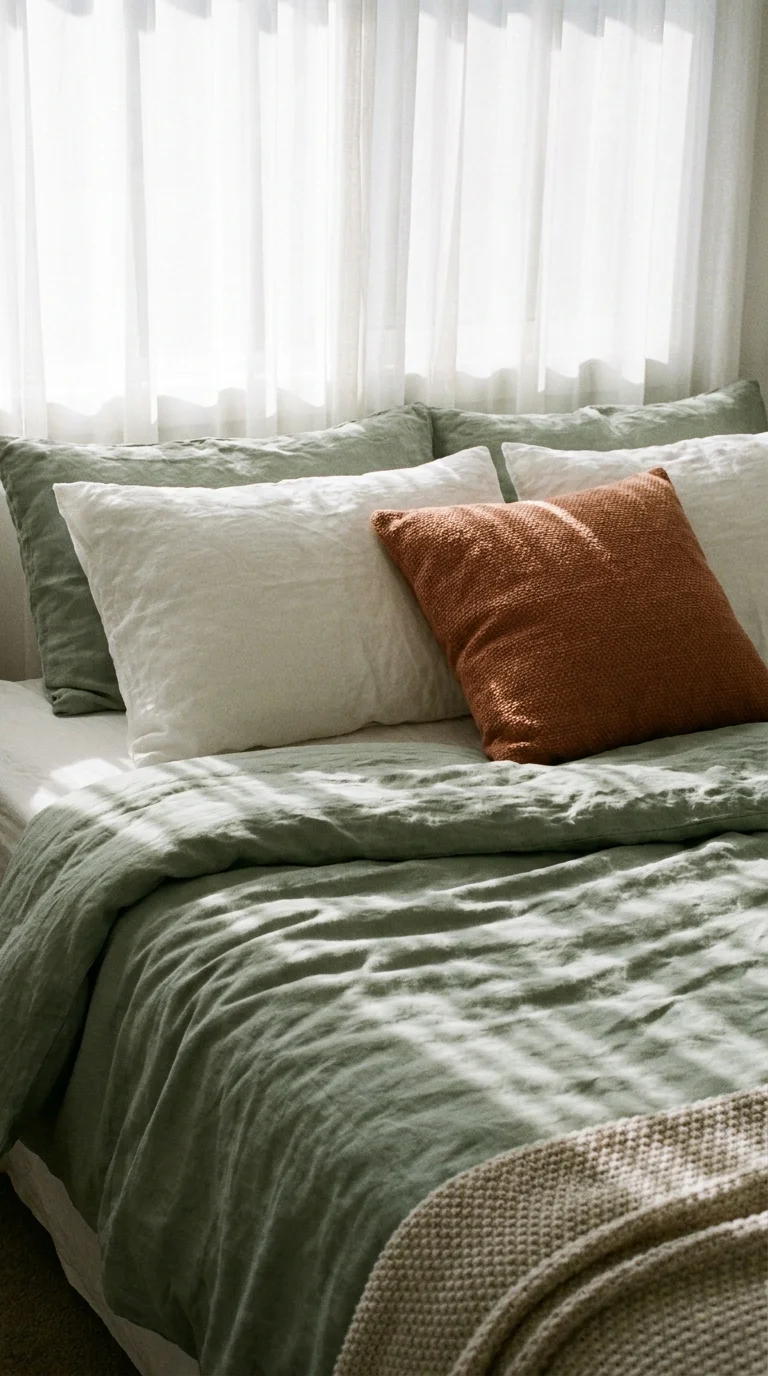
You don’t need to repaint a single wall to get a sage bedroom vibe. Sometimes all you need is the right bedding.
Sage green duvet covers have exploded in availability in the last few years, and you can find genuinely beautiful linen-look options without buying actual linen (which can get pricey fast).
I picked up a washed cotton duvet cover in sage green from IKEA’s ÄNGSLILJA line — it cost around $45, and the slightly crinkled texture gives it that relaxed, organic feel that expensive linen has. I threw two oversized white pillowcases on either side, and it looked like a hotel room.
The look: Sage duvet, white pillowcases, one or two throw pillows in a complementary color (terracotta works beautifully, as does cream or dusty pink).
Budget bedding sources:
- IKEA — consistently affordable, surprisingly good quality in the higher-end lines
- Amazon Basics — not glamorous, but the sage duvet covers are decent
- H&M Home — they run sales frequently, and their linen-blend covers are genuinely lovely
- Target’s Threshold line — solid quality, good sage options, often 20% off with a Target Circle coupon
One thing I’d warn against: buying a duvet cover that’s too light in color. What looks like a warm sage green on a product photo can show up as a weird grey-green in real life under artificial bedroom lighting. Read the reviews and look for buyer photos, not just the professional product shots.
Look 3: The Thrift Store + Sage Paint Combo (Budget: $20–$50)
This one is my personal favorite because it feels like actual magic when you pull it off.
Old wooden furniture — dressers, nightstands, picture frames, small shelves — can be found at Goodwill, Facebook Marketplace, or garage sales for almost nothing. A wooden nightstand that costs $8 at a thrift store? Paint it sage green, add a new knob from Amazon (a set of ceramic or brass knobs costs around $12–$15), and suddenly you have a piece that looks like it’s from a boutique furniture store.
I did this with a beat-up wooden dresser I found on Facebook Marketplace for $15. I sanded it lightly, primed it, painted it sage, swapped the knobs for matte gold ones, and it became the most-commented piece in my entire bedroom.
What you need:
- A small can of chalk paint or furniture paint in sage (Annie Sloan is amazing but pricey — Rust-Oleum’s chalk paint at around $14 a can works almost as well)
- Fine-grit sandpaper
- A foam roller for smooth coverage
- New hardware if the old stuff is ugly
Pro tip: Chalk paint doesn’t always need primer on furniture, which saves you a step and some money. It’s also very forgiving of imperfections, which is ideal for beginner painters.
Look 4: The Botanical Print Gallery Wall (Budget: $15–$45)
Here’s something nobody really talks about enough: the right wall art can make a sage bedroom feel ten times more pulled together without spending much at all.
Botanical prints — think leaves, ferns, simple plant illustrations — complement sage green walls in a way that feels totally natural. Literally. It’s like bringing the outside in, but in a very calm, curated way.
I downloaded free botanical prints from Canva (they have free plant illustrations in the design elements library) and Unsplash (search “botanical illustration” for free high-res images), printed them at my local print shop on cardstock for about $1–$2 each, and popped them into cheap black frames from IKEA’s RIBBA line (about $3–$5 each).
For a gallery wall of five prints, I spent under $30 total.
The arrangement: Don’t overthink the layout. Lay the frames on the floor first and shuffle them around until you like the grouping. I use a level app on my phone (most phones have one built in) and painter’s tape to mark where nails should go before I commit.
Free art sources:
- Canva (free account)
- Unsplash.com
- The British Museum Collection (free to download public domain art)
- Rawpixel.com — lots of botanical vintage illustrations, free tier available
Look 5: The Rattan Mirror Moment (Budget: $25–$60)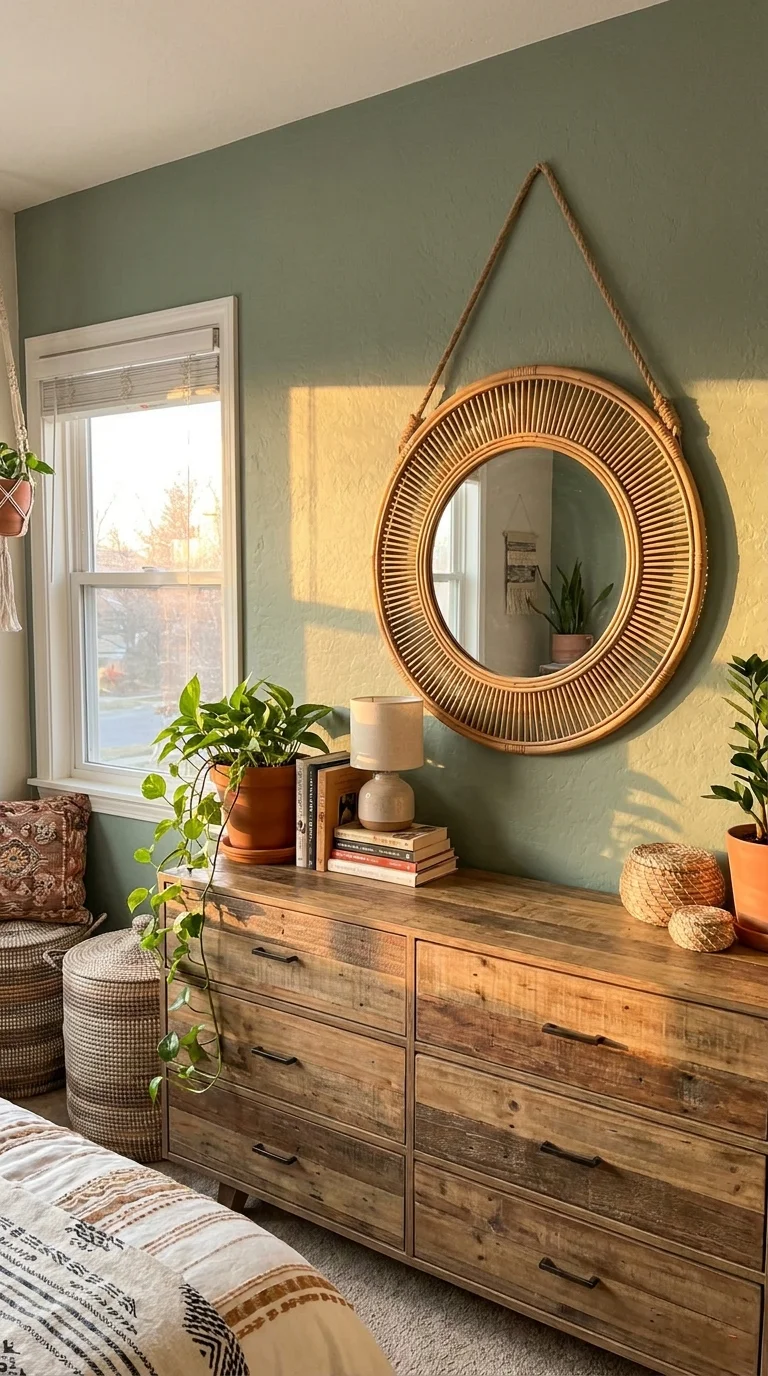
If there’s one accessory that works harder in a sage bedroom than almost anything else, it’s a rattan or woven mirror.
The natural texture of rattan against a sage green wall creates this earthy, grounded feel that’s very of-the-moment but also timeless. It doesn’t feel like a trend. It just feels right.
I found a circular rattan mirror on Amazon for around $35 — it was 24 inches across, just the right size for my wall above my dresser. Hung it up, and the entire room felt warmer and more cohesive.
Where to look:
- Amazon (search “rattan round mirror” — filter by reviews)
- TJ Maxx / HomeGoods in-store — they get these in regularly, and prices are often better than online
- World Market — frequently runs 40% off sales
- IKEA’s LUSÄRV — not rattan but a woven texture, very affordable
Size tip: In a bedroom, go bigger than you think you need. A mirror that looks large in the store or in a product photo often feels underwhelming on an actual wall. I’d suggest nothing smaller than 20 inches for a bedroom wall mirror.
Look 6: The Cozy Textured Layer (Budget: $20–$55)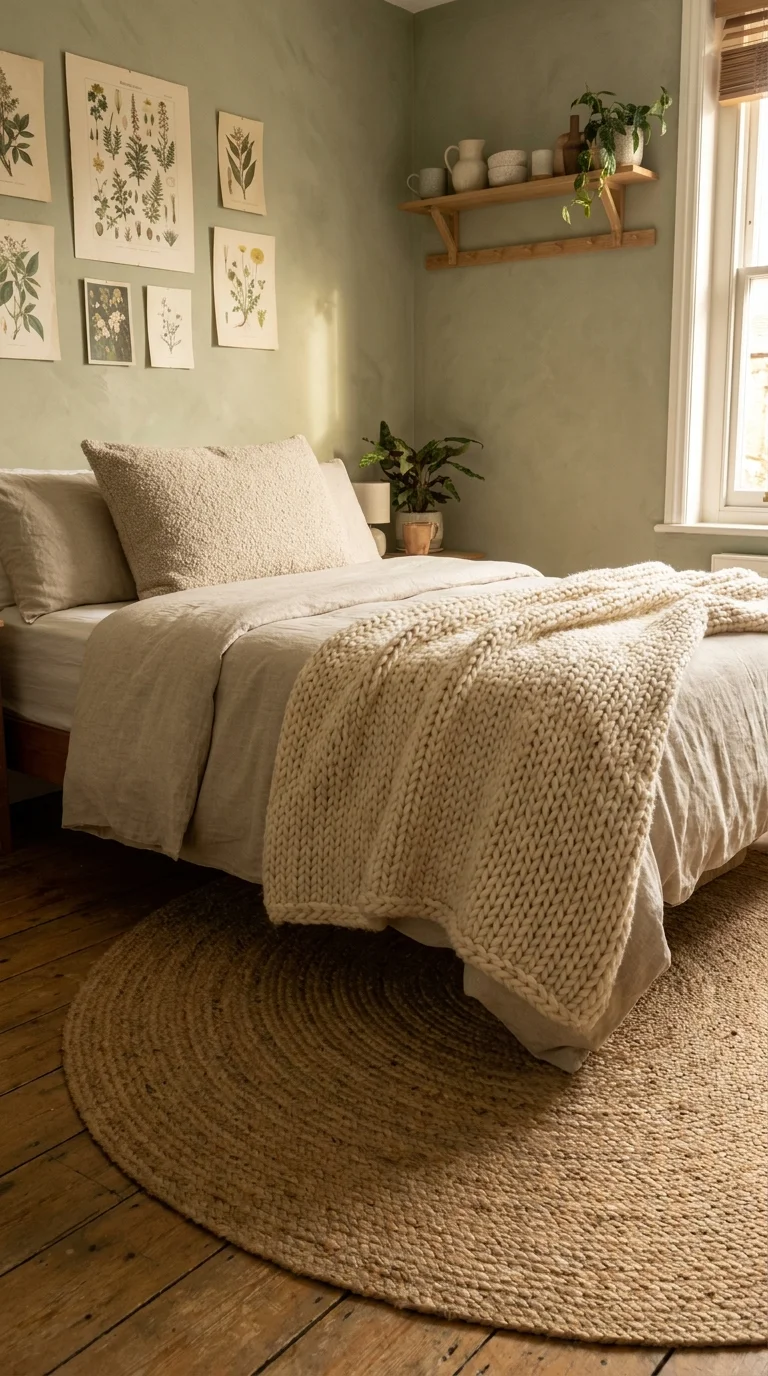
One thing that separates a bedroom that feels designed from one that just has a color scheme is texture. When everything is flat and smooth, even a beautiful sage room can feel cold and sterile.
Layering textures is the secret. And it doesn’t cost much.
I’m talking about:
- A chunky knit throw blanket at the foot of the bed (Target, Amazon, HomeGoods all carry these)
- A woven jute rug under or beside the bed
- A velvet or boucle throw pillow
Each of these items individually costs $15–$25. Together, they make the room feel like a boutique hotel.
For the rug, I specifically love jute or natural fiber options in a sage bedroom because the earthy, warm texture grounds the cool-green walls perfectly. IKEA’s LOHALS jute rug is around $30 for a decent size, and it’s held up remarkably well over two years.
My mistake: I initially got a rug that was too small. Rugs almost always need to be larger than you think. For a queen bed, a 5×8 rug is the minimum — 8×10 is ideal if your budget can stretch. A too-small rug makes the whole room feel off without you being able to put your finger on why.
Look 7: The Plant-Forward Sage Bedroom (Budget: $10–$40)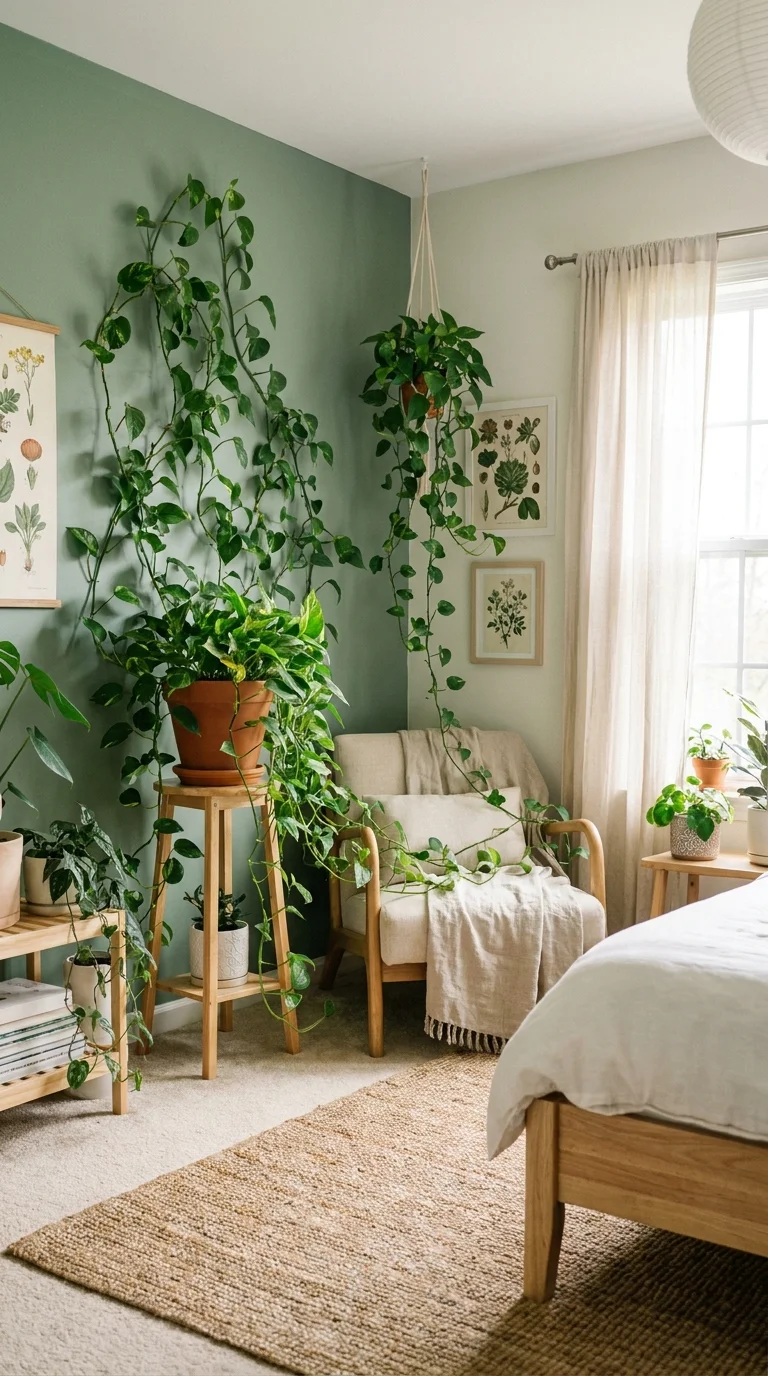
Okay, this one is almost too obvious when you think about it — if you have sage green walls, bringing in actual plants feels like the most natural next step in the world.
But not just any plants dumped randomly around the room. A bit of intention goes a long way.
One large plant in the corner (a pothos, a snake plant, or a peace lily — all low-light tolerant and cheap) makes a dramatic statement. A small succulent or two on a windowsill or nightstand adds life without clutter.
I picked up a large golden pothos from my local nursery for $12 and put it in a terracotta pot from Home Depot (around $4). That combination — the green trailing plant, the terracotta pot, against my sage accent wall — became the most photographed corner of my apartment.
Best low-maintenance bedroom plants:
- Snake plant — nearly indestructible, tolerates low light
- Pothos — fast-growing, trails beautifully
- ZZ plant — thrives on neglect, very architectural
- Peace lily — one of the few flowering plants that does well indoors in low light
For pots, terracotta is your best friend in a sage bedroom — the warm orange-brown is a perfect contrast to the green. You can buy plain terracotta pots at Home Depot or Walmart for $2–$6 depending on size.
Look 8: The Warm Wood and Sage Combination (Budget: $0–$80)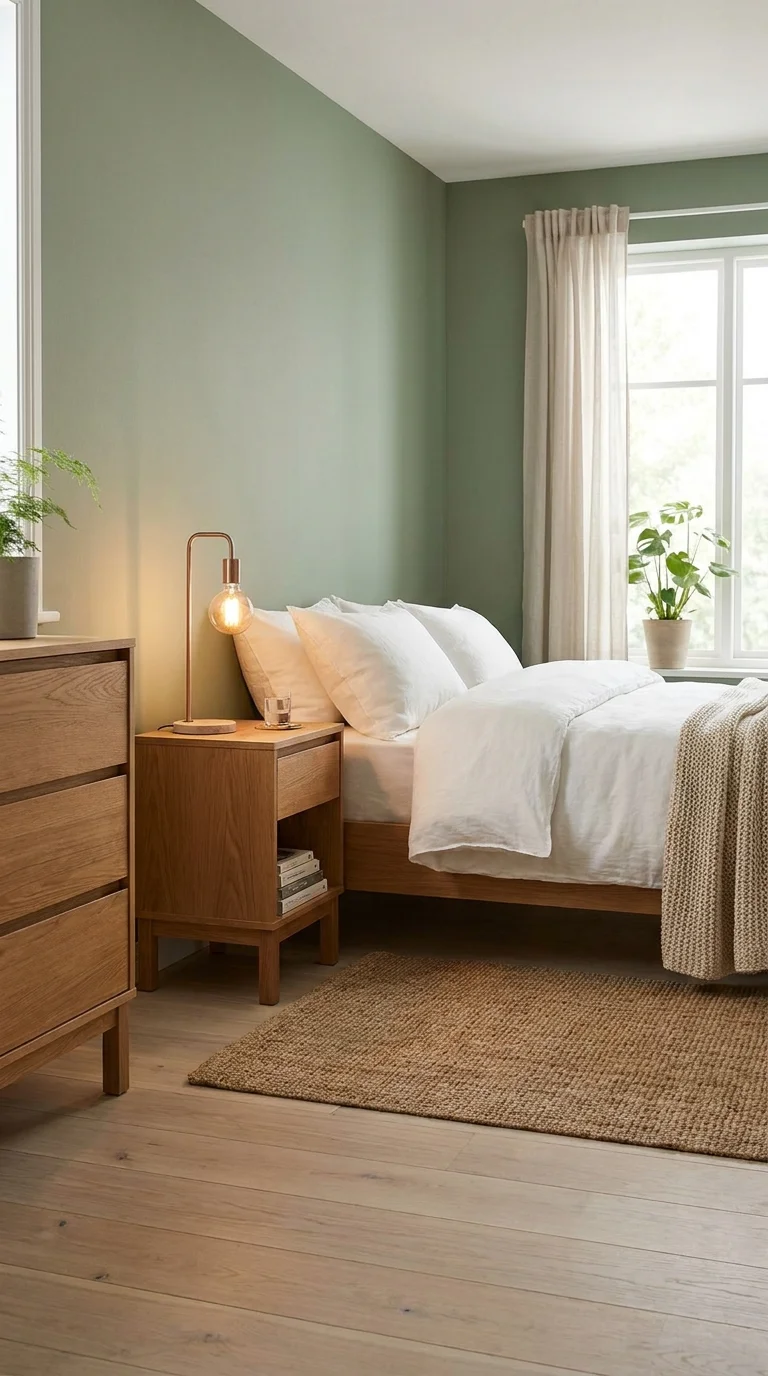
Here’s a look that costs nothing if you already have wood-toned furniture — or very little if you need to add just a piece or two.
Warm wood tones (oak, pine, walnut, even light bamboo) are probably the single best complement to sage green. The combination feels natural, Scandinavian, grounded. Think IKEA showroom but warmer and more personal.
If you already have a wooden dresser, desk, or nightstand, congratulations — you’re halfway there. Just move them into your sage bedroom and let them breathe.
If you don’t have any wooden pieces, here’s what I’d prioritize:
- A wooden nightstand or side table (Facebook Marketplace is incredible for this — I’ve seen solid oak nightstands for $10–$20)
- A wooden picture frame or two mixed in with your gallery wall
- A small wooden tray on your dresser for jewelry, a candle, and a plant
What doesn’t work as well: Very dark-stained wood (ebony, dark walnut) can sometimes fight with sage and make the room feel heavier than you want. Medium tones — honey oak, mid-walnut, light ash — are the sweet spot.
Look 9: The Full Room Transformation on Under $150 (Budget: $100–$150)
Alright, this is the big one. The one I actually did in my own bedroom. A complete sage green transformation from beige nightmare to genuinely beautiful room, for right around $140.
Here’s exactly how I broke it down:
The breakdown:
- One quart of sage paint for accent wall: $22
- Foam roller, painter’s tape, tray: $12
- Sage duvet cover from IKEA: $45
- Two white pillowcases: already owned
- One rattan mirror from Amazon: $35
- Three botanical prints printed at a copy shop: $6
- Two IKEA RIBBA frames: $8
- One pothos plant + terracotta pot: $16
Total: $144
The result was something I would have described as impossible for that price if I hadn’t done it myself. My bedroom went from a room I avoided spending time in to the place I genuinely love being most in my apartment.
The order I’d recommend doing it:
- Paint first (it’s the cheapest, biggest-impact change and sets the tone for everything else)
- New bedding next (the focal point of the room)
- Mirror or wall art (frames the space)
- Plants and small accessories last (they fill in the personality)
Common Mistakes I’ve Seen (And Made)
Mixing too many shades of green. Sage works beautifully, but if you add lime-green throw pillows, a forest-green rug, and a mint-green lamp, the room starts to feel like a greenhouse. Pick sage as your primary color and let everything else be neutral or earthy.
Going too dark. Some sage greens lean dark and moody, which is beautiful — but if your bedroom doesn’t get a lot of natural light, a very dark sage will make the room feel smaller and heavier. Swatch before you commit.
Buying cheap bedding just because the color is right. I made this mistake once. A $19 sage polyester duvet cover looked exactly like a $19 sage polyester duvet cover. It pilled within a month, and the color faded in two washes. Spend a little more on bedding — it’s the thing you touch and look at every single day.
Ignoring lighting. A sage bedroom looks incredible in warm, soft light. Under harsh overhead white light, it can look flat and uninspiring. A lamp or two with warm-toned bulbs (look for bulbs labeled 2700K–3000K) can make an enormous difference and don’t have to cost much. I picked up two small table lamps at HomeGoods for $18 each and swapped in warm LED bulbs.
Over-accessorizing. Less is genuinely more in a sage bedroom. The color does the work. You don’t need to fill every surface. A few well-chosen things look more deliberate — and more expensive — than a cluttered collection of budget items.
One More Thing Before You Start
Don’t wait until you have the “perfect” amount of money or the “perfect” room. I kept telling myself my bedroom wasn’t worth decorating because I was renting, or because I didn’t have the right furniture yet, or because the room was too small.
None of that was actually the reason. I was just afraid to start.
Start with the paint. Or start with the bedding. Or find one rattan mirror on Facebook Marketplace and put it on your wall.
The point is to start somewhere. Because a beautiful sage bedroom — the kind that makes you genuinely happy to come home to — doesn’t require a big budget. It just requires a little intention and a willingness to try.
And if you end up painting something the wrong color or buying a rug that’s too small? That’s fine. That’s how you learn. That’s how I learned.
Good luck — and honestly, sage green is going to look incredible in your space.
Have questions about any of these looks? Drop them in the comments below — I answer every one.

Shahid Nawaz is a home and garden content writer at Garden Skillz with over 4 years of experience researching and writing about gardening, plant care, and DIY home improvement. He specializes in turning complex horticultural topics into practical, easy-to-follow guides for beginners and experienced growers alike. Shahid has written extensively on flowering plants, indoor greenery, and seasonal garden care.