I’ll be honest — the first time I planted in a barrel, I had zero idea what I was doing.
It was a Saturday morning in early spring, my neighbor had just dropped off an old whiskey barrel that had been sitting in his shed for years, and I thought, “How hard can it be?” I filled it with topsoil straight from a bag, shoved in a tomato plant, watered it, and called it a day.
By July, that tomato plant looked like it was auditioning for a horror movie. Yellowing leaves. Stunted growth. Completely embarrassing, especially since my neighbor could see it from his kitchen window.
But here’s the thing — that failure taught me more about barrel planters than any YouTube video ever did. And over the years, I’ve gone from that sad, drooping tomato to a backyard that neighbors stop to photograph. Barrels are now my absolute favorite way to add life, height, and drama to a garden space.
If you’re curious about what actually works (and what absolutely doesn’t), you’re in the right place. Let me walk you through 12 barrel planter ideas that have genuinely transformed my garden — and my relationship with outdoor growing.
Why Barrel Planters Are Worth Every Penny?
Before we get into the actual ideas, let me make a quick case for barrel planters if you’re on the fence.
First, they’re deep. Most whiskey barrels run 18 to 24 inches deep, which means you can grow things that shallow pots can never support — deep-rooted herbs, cascading flowers, even compact fruit trees. Second, they hold moisture really well, which is a lifesaver if you tend to forget watering (no judgment, I forget too). And third, they look incredible. There’s something about a weathered wooden barrel that makes a garden feel intentional and lived-in rather than thrown together.
Half barrels, full barrels, wine barrels — they all work brilliantly. You just need to know what you’re doing with them.
1. The Classic Cottage Garden Barrel

This is where I’d tell any beginner to start.
Pick a half whiskey barrel and fill it with a mix of cottage garden favorites — lavender in the center for height, trailing petunias around the edges, and maybe some sweet alyssum to spill over the sides. The result looks like something off a Pinterest board, but it’s actually one of the easiest combos to pull off.
The key here is the “thriller, filler, spiller” formula that any good nursery worker will tell you about. One tall focal plant (the thriller), bushy plants to fill the middle (the filler), and trailing plants that drape over the edges (the spiller). Follow that rule, and a barrel planter basically styles itself.
What I learned the hard way: Don’t mix plants with wildly different water needs in the same barrel. I once paired lavender (which hates soggy roots) with impatiens (which needs constant moisture), and I lost both within three weeks. Know your plant’s preferences before combining them.
2. The Herb Barrel Kitchen Garden

This idea changed my cooking life more than my garden life, which I genuinely wasn’t expecting.
I positioned a half barrel right outside my back door — literally three steps from the kitchen — and planted it with basil, rosemary, thyme, chives, parsley, and one small sage plant. Every single evening when I’m cooking, I walk out with scissors and snip whatever I need.
The barrel is perfect for herbs because the depth encourages strong root development, and the wood naturally regulates moisture, so the soil doesn’t dry out as fast as terracotta pots. Rosemary especially thrives — mine grew so thick in the second year that I started giving bundles away to people at work.
Pro tip: Plant your most-used herbs closest to the edge so they’re easy to access without reaching over everything else. Sounds obvious, but it took me an embarrassing amount of time to figure that out.
For drainage, I always drill five or six holes in the bottom of any barrel I use for herbs. Even if it comes with holes, I add more. Herbs hate sitting in water, and barrels can hold a surprising amount of moisture.
3. The Dramatic Ornamental Grass Barrel

If you want something that looks spectacular even in winter, this is your move.
Plant a single ornamental grass — Karl Foerster feather reed grass is my personal favorite — in the center of a full-sized barrel and surround the base with low-growing sedums or creeping jenny. The grass grows tall and architectural, moves beautifully in a breeze, and turns a gorgeous golden color in autumn.
What most people don’t realize is that ornamental grasses are almost impossible to overwater or neglect into dying. They’re brutally forgiving. I’ve left mine for two weeks in the summer heat without a single drop of water, and it came back looking fine. Paired with the barrel’s visual weight, this combo reads as intentional and sophisticated, even though it requires almost zero effort.
The trick is choosing the right barrel size. Full barrels (not halves) work better here because grasses develop impressive root systems. If you crowd them into a half barrel, growth gets restricted, and you lose that dramatic height effect you’re going for.
4. The Raised Vegetable Barrel Garden

This is the idea I wish someone had told me about when I was first starting.
Instead of putting in a raised bed (which requires building, materials, and a permanent footprint), I used four half barrels arranged in a loose cluster near my sunniest fence. I planted tomatoes in two of them, zucchini in one, and bush beans in the fourth.
The results genuinely surprised me. Because the barrels elevate the soil, it warms up faster in spring — which means earlier planting and earlier harvests. My tomatoes were producing almost three weeks before my neighbor’s in-ground plants. He was not happy about this.
Also, pests are significantly less of a problem. Slugs especially — they can’t easily climb the wooden sides, and since the barrels sit above ground level, there’s just less contact with soil-dwelling critters.
Important note: Vegetables are heavy feeders. With barrels, you need to fertilize regularly because nutrients get used up faster in a contained growing space. I use a slow-release granular fertilizer at planting time, then liquid feed every two weeks once plants are established. Don’t skip this step, or you’ll wonder why everything looks pale and sad by midsummer.
5. The Pollinator Paradise Barrel

A few years ago, I noticed my vegetable garden wasn’t producing as well as it should. Tomatoes weren’t setting fruit. Courgettes were flowering, but nothing was developing. The problem? Not enough pollinators in my garden.
So I dedicated one barrel entirely to pollinator-friendly plants — borage, echinacea, marigolds, and a dwarf lavender at the back. Within one season, my whole yard felt different. Bees everywhere. Butterflies landing on everything. And my vegetable yields went through the roof.
What makes this work particularly well in a barrel is that you can position it anywhere — wheel it right next to your vegetable beds during flowering season if you want. That mobility is something you just can’t replicate with in-ground planting.
Borage is my top recommendation for this setup, by the way. It self-seeds like mad, it’s stunningly beautiful in a barrel, and bees are absolutely obsessed with it. I have it in three barrels now, and I’ll never go back.
6. The Dramatic Water Feature Barrel

This took me a couple of summers to finally attempt because I thought it would be complicated. It’s not.
You seal the inside of a full barrel with a pond liner or a barrel-specific sealant (I used one called Red Devil for the first attempt, then switched to a proper flexible pond liner stapled at the rim — the liner is far more reliable). Fill it with water, add a small solar-powered pump from Amazon for about £25-£30, and plant aquatic plants like water lilies, water hyacinth, or iris around the edges.
The sound of trickling water in a garden is genuinely underrated. It masks road noise, it’s relaxing, and it attracts birds. Within two weeks of setting mine up, I had sparrows bathing in the overflow dish I placed underneath.
Lessons from my failures: The sealant-only method works but needs reapplying every couple of years as wood expands and contracts with temperature changes. The pond liner method is more work up front, but lasts much longer. Also, place it in partial shade — full sun causes rapid algae growth, and you’ll spend more time maintaining water clarity than enjoying it.
7. The Tiered Barrel Display

This one gets the most comments whenever people visit my garden.
I positioned three barrels of different heights together — a full barrel, a half barrel on a small wooden stand, and an old wine barrel crate used as a very shallow planter. Staggering the heights creates a tiered display effect that looks like something from a garden center showroom but costs next to nothing to put together.
Each barrel has a different planting theme: the tallest has a tall ornamental grass, the mid-height one has trailing geraniums and petunias, and the lowest crate has succulents. The varying heights mean every plant gets good light without competing, and from a visual standpoint, the eye moves naturally through the display rather than getting stuck on one flat level.
You don’t need to buy matching barrels for this. Mismatched wood tones and styles actually look better — more organic, more “collected over time” rather than “bought in a set.”
8. The Strawberry Barrel Tower
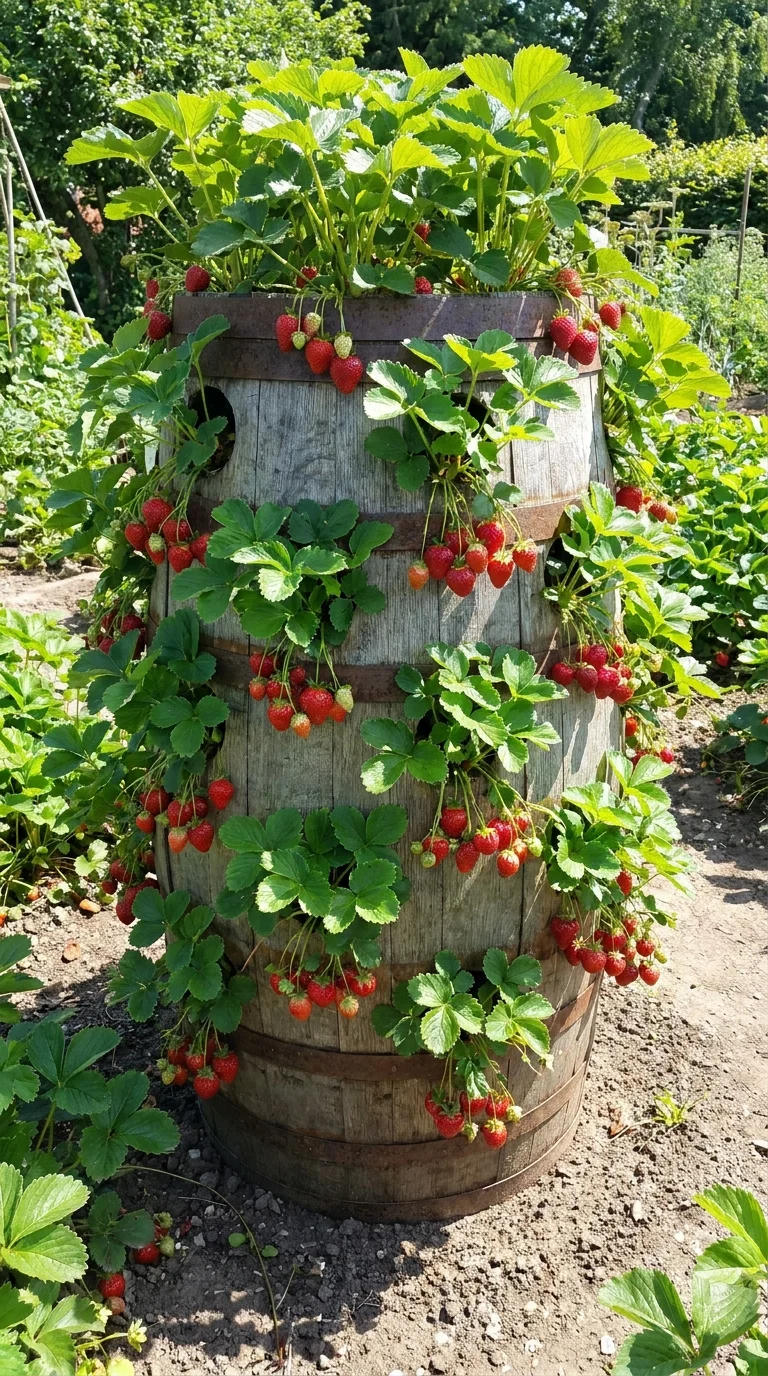
If you have kids, do this one immediately.
A strawberry barrel is essentially a full barrel with additional holes drilled into the sides at staggered heights. You plant strawberries through each hole as well as across the top, creating a tower of plants that produces fruit from base to crown. It’s genuinely one of the most charming things you can grow.
The drilling part seems intimidating, but it’s straightforward with a 2-inch hole saw attachment on a standard drill. Space the holes about 8 inches apart in a spiral pattern around the barrel so no plant is directly above another (otherwise the upper plants drip water onto lower ones and can cause rot).
I plant ever-bearing varieties rather than June-bearing ones because they produce fruit continuously through summer rather than all at once. Mara des Bois is my favorite — incredibly sweet, produces from June through October, and the plants stay compact enough for barrel growing without taking over.
My kids actually check the barrel every single morning during summer. There’s something about fruit coming out of an unexpected place that children find completely magical.
9. The Mediterranean Barrel Garden
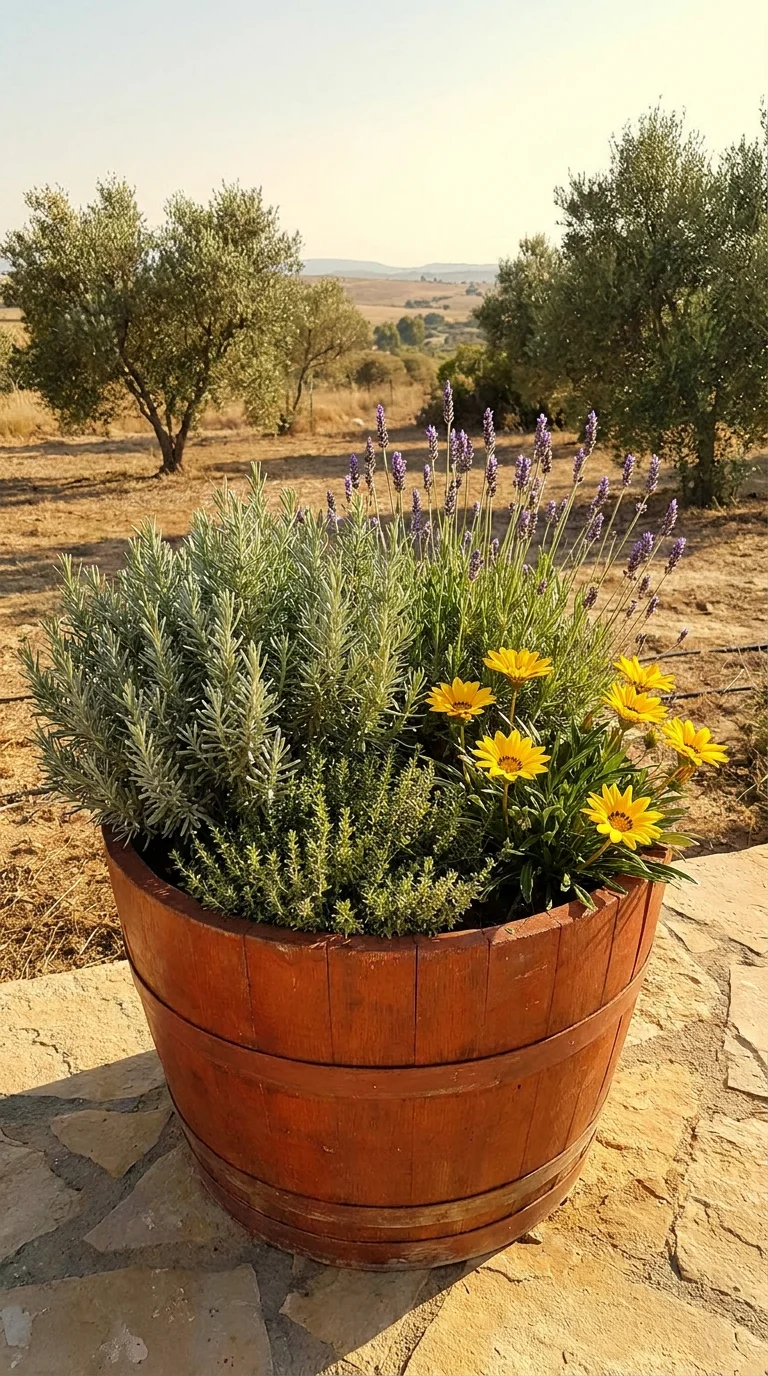
This idea works especially well if you’re in a warm, dry region or if you have a sun-baked patio.
Fill a barrel with extremely well-draining soil (I mix regular potting soil with about 30% horticultural grit), then plant a combination of Mediterranean herbs and flowers — rosemary, lavender, thyme, cistus, and trailing gazanias. The result is a heat-tolerant, drought-resistant display that actually looks better the hotter and drier your summer gets.
The barrel’s wooden walls help protect roots from extreme temperature swings while also allowing the soil to breathe — which is something terracotta does too, but barrels do it on a much more dramatic scale because of the sheer volume of soil they hold.
This setup is ideal if you hate constant watering. Once established (usually by the second month), Mediterranean plants in a barrel can go a full week without water during dry summer spells. Some of mine go longer. Rosemary especially seems to thrive on a degree of neglect that would kill most other plants.
10. The Shade-Loving Woodland Barrel

Most barrel planter guides focus on sunny spots. This one’s for the other half of us.
My back corner gets maybe three hours of direct sun on a good day. For years, I treated it as a lost cause. Then I got a barrel, filled it with shade-friendly plants — hostas, ferns, astilbe, and a trailing heuchera for color — and placed it in that dim corner.
It’s now the most lush-looking corner of my entire garden.
Hostas especially love barrel growing because the depth gives their roots room to spread without competing with tree roots or other plants, which is usually the problem in genuinely shaded in-ground spots. The barrel essentially gives you a fresh start in a difficult area.
Shade barrel tip: Pale-colored flowers and variegated leaves make shaded areas appear brighter. White astilbe, cream-edged hostas, and lime-green heuchera reflect whatever light is available, and the space feels airy rather than dark and gloomy.
11. The Cut Flower Barrel
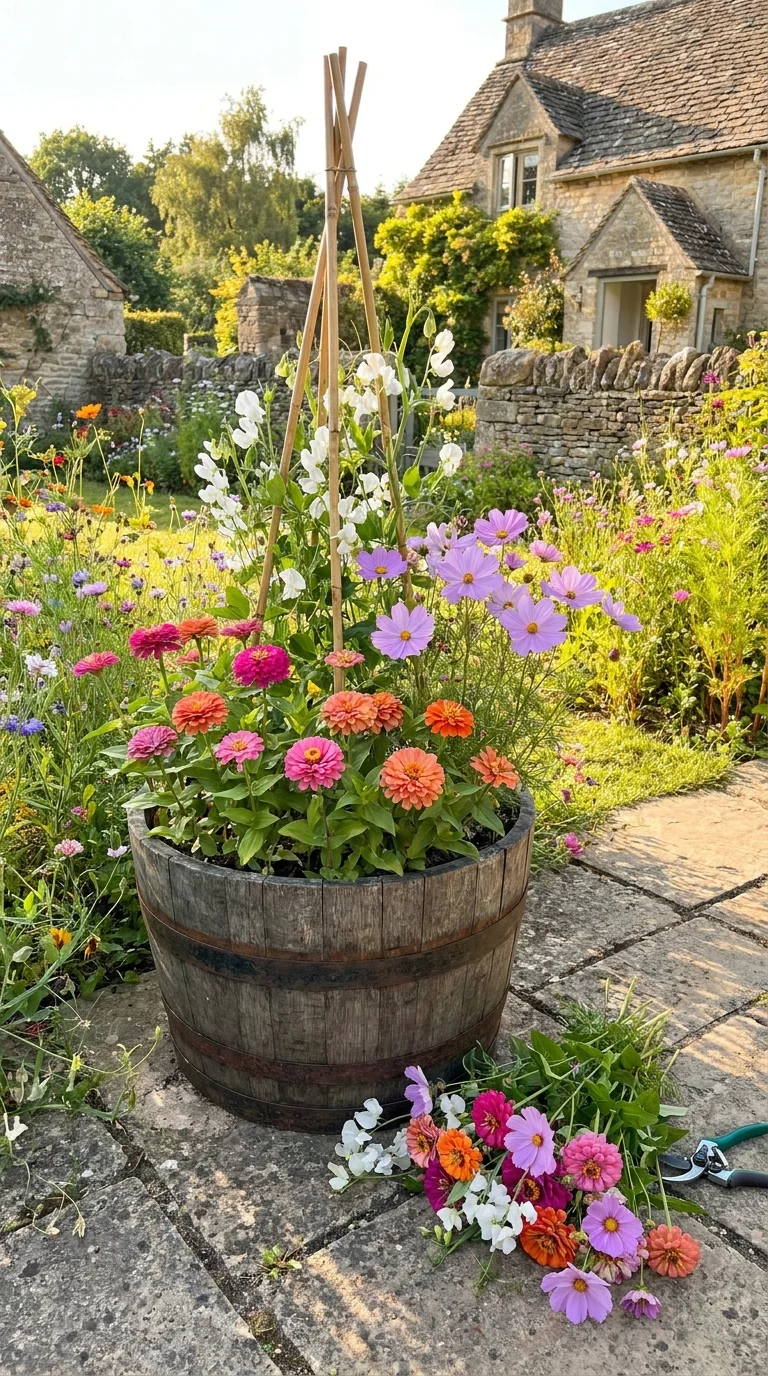
This one came out of desperation during a summer when I kept spending money on supermarket flowers.
I planted a barrel entirely with cutting garden favorites — zinnias, cosmos, sweet peas trained up a small bamboo tripod in the center, and lisianthus around the edges. From July through September, I was cutting fresh flowers for the house every single week.
The trick with a cut flower barrel is succession planting. Rather than planting everything at once, I plant in small batches two weeks apart. This means I’m not getting all my flowers at the same time with a long gap afterward — instead, there’s always something just about to open when the previous batch is being cut.
Sweet peas are the absolute star of this setup. They smell extraordinary, they produce more flowers the more you cut them, and they climb naturally up a central support without needing much help. If you only do one thing with a barrel this season, plant sweet peas in it. You won’t regret it.
12. The Year-Round Seasonal Barrel

This is probably the most practical idea of the lot, and it’s the approach I use for the barrel that sits at my front door, where everyone can see it.
The concept is simple: you replant the barrel four times a year to match the season. Spring gets bulbs (tulips, daffodils, hyacinths) with violas and pansies around the base. Summer gets a bold tropical arrangement — canna lily, coleus, and trailing bacopa. Autumn gets ornamental kale, late dahlias, and Japanese anemone. Winter gets evergreen ivy, cyclamen, and a couple of stems of dogwood for structural interest.
Yes, it’s more work than planting once and walking away. But the payoff is that your garden always looks intentional and current, not like you planted something three years ago and forgot about it.
I keep a simple note in my phone for what I plant each season, with a photo, so I can remember what worked and what I want to repeat. This takes about 30 seconds but has saved me from making the same mistakes twice.
The Soil Question Everyone Gets Wrong
I want to spend a minute on this because bad soil is the single biggest reason barrel planters fail.
Never — and I really mean never — fill a barrel with garden soil straight from your yard. Garden soil compacts badly in containers, drains poorly, and often introduces pests and disease. I made this mistake once and lost a whole summer’s planting to what I think was some kind of fungal issue from soil that hadn’t been properly composted.
Use a quality potting mix formulated for containers. I’ve used John Innes No. 2 for most of my barrels, but any good peat-free potting compost works well. For vegetables, I add slow-release fertilizer granules mixed in at planting time. For Mediterranean and drought-tolerant plants, I cut the compost with grit as I mentioned earlier.
Also, don’t skip the drainage layer. I put an inch of broken crocks or coarse gravel at the bottom of every barrel before adding soil. It stops the drainage holes from clogging with fine compost particles over time.
Common Mistakes That’ll Cost You a Season
I’ve made most of these myself, so no judgment here.
Planting too deeply for the barrel’s size. A half barrel is great for most things, but not for plants that need serious vertical root space — deep-rooted vegetables like carrots or parsnips will just hit the bottom and fork. Choose barrel size to match plant root needs.
Forgetting about weight. A full barrel of wet soil is genuinely heavy. I once filled a barrel on my deck and then realized I needed to move it six feet to the left. It took four people and a moving dolly. Plan where it’s going before you fill it.
Not checking for drainage. Some new barrels don’t come with holes pre-drilled. Check before you fill, not after.
Overwatering in the belief that a bigger container means more water is needed. More soil volume actually means the compost holds moisture longer. Let the top inch dry out before watering again — stick your finger in and check rather than watering on a schedule.
Buying one barrel, planting too many plants, and wondering why nothing thrives. Overcrowding is real. Plants need space for roots and air circulation. Better to have three confidently spaced plants than eight competing ones.
A Few Tools That Make Barrel Gardening Easier
Not sponsored, just genuinely useful things I use:
A good moisture meter (I use a basic one I found on Amazon for about £8) takes all the guesswork out of watering. You push the probe into the soil, and it tells you immediately whether it’s dry, moist, or wet. Game-changer for barrels.
A small hand truck or barrel dolly is worth every penny if you plan on moving barrels around. They’re not cheap, but neither is a bad back.
For drilling extra drainage holes, a standard cordless drill with a 1/2-inch bit works perfectly. No need for anything fancy.
And a simple watering can with a long-reach spout is much better than a hose for barrels — you can direct water exactly where you want it without disturbing surface plants or splashing the foliage of plants that hate wet leaves (tomatoes, I’m looking at you).
Final Thoughts
Barrel planters have become such a central part of my garden that I honestly can’t imagine doing without them now. They’ve solved problems I didn’t know I had — difficult shaded corners, limited space, and the inability to grow deep-rooted vegetables in my clay-heavy in-ground beds.
But more than the practical stuff, there’s something genuinely satisfying about a well-planted barrel. It’s a contained, manageable thing in a hobby that can often feel overwhelming and out of control. You can plan it, execute it, and actually see the results clearly without a lot of noise around it.
Start with one. Pick whichever of these 12 ideas genuinely excites you and commit to it properly — good soil, correct drainage, appropriate plant selection. Once you see how it transforms your space, I guarantee you’ll be scouting for your second barrel before the season’s out.
I’ll see you at the garden center.
Have a barrel planter idea I didn’t cover? Drop it in the comments — I’m always looking for new experiments to try in my garden.

Shahid Nawaz is a home and garden content writer at Garden Skillz with over 4 years of experience researching and writing about gardening, plant care, and DIY home improvement. He specializes in turning complex horticultural topics into practical, easy-to-follow guides for beginners and experienced growers alike. Shahid has written extensively on flowering plants, indoor greenery, and seasonal garden care.